
Comprehensive Guide to Rollback Triggers in Enterprise AI Runbooks

Introduction to Rollback Triggers
In enterprise AI runbooks, Rollback Triggers serve as automated safeguards that detect deployment issues and revert to a stable previous version. These triggers are critical for minimizing downtime, protecting user experience, and ensuring compliance in high-stakes AI environments. By defining precise conditions for rollback, teams can respond to failures in seconds rather than hours.
Rollback Triggers integrate seamlessly with CI/CD pipelines, monitoring tools, and AI-specific metrics like model drift or inference latency spikes.
Key Benefits of Rollback Triggers
- Rapid Recovery: Automatically revert changes within seconds of detecting issues.
- Reduced Human Error: Eliminates manual intervention in panic situations.
- Compliance Assurance: Logs all trigger events for audit trails.
- Cost Savings: Prevents prolonged exposure to faulty models that incur high compute costs.
- Scalability: Handles thousands of microservices or model variants effortlessly.
Types of Rollback Triggers
1. Metric-Based Triggers
Monitor quantitative KPIs such as:
- Error rates exceeding 5%.
- Latency increases beyond 200ms p95.
- CPU/memory utilization spikes over 90%.
2. Anomaly Detection Triggers
Leverage AI-driven anomaly detection:
- Sudden drops in model accuracy.
- Unusual traffic patterns indicating A/B test failures.
- Data drift scores surpassing predefined thresholds.
3. Canary and Blue-Green Triggers
Deployment-specific triggers:
- Canary rollout failure, for example <80% healthy instances.
- Blue-green switchback on shadow traffic discrepancies.
4. Manual and External Triggers
- API endpoints for on-demand rollbacks.
- Integration with PagerDuty or Slack for human override.
Configuring Rollback Triggers: Step-by-Step
Step 1: Define Trigger Conditions
In your runbook YAML configuration:
- Set thresholds:
error_rate > 0.05 for 2m. - Specify evaluation windows: rolling 5-minute averages.
- Add hysteresis to prevent flapping:
>5% up, <3% down.
Step 2: Select Rollback Scope
Choose granularity:
- Model-Level: Revert specific AI model versions.
- Service-Level: Rollback entire microservice.
- Cluster-Level: Revert Kubernetes deployments.
Step 3: Integrate Monitoring
Connect to tools like Prometheus, Datadog, or custom AI observability platforms:
- Export metrics via
/metricsendpoint. - Define alerts with
PromQLqueries. - Enable webhook notifications for external systems.
Step 4: Test Triggers
- Dry-Run Mode: Simulate failures without actual rollbacks.
- Chaos Engineering: Inject faults using tools like Gremlin.
- Historical Replay: Test against past incident data.
Step 5: Deploy and Monitor
- Roll out via GitOps, for example ArgoCD or Flux.
- Set up dashboards for trigger history.
- Review false positives weekly.
Best Practices for Effective Rollback Triggers
- Multi-Trigger Logic: Use AND/OR combinations, for example high error AND latency.
- Grace Periods: Allow 30–60s warmup post-deployment.
- Version Pinning: Always rollback to known-good versions, not latest.
- Alert Fatigue Prevention: Group related metrics into composite triggers.
- Post-Rollback Analysis: Auto-generate incident reports.
Common Pitfalls and Solutions
| Pitfall | Solution |
|---|---|
| False Positives | Increase evaluation window and add multiple conditions. |
| Slow Detection | Use sub-minute polling intervals. |
| Incomplete Rollbacks | Verify rollback success with health checks. |
| Overly Aggressive Triggers | Implement staged rollbacks, for example 50% → 100%. |
Advanced Features
- ML-Optimized Triggers: Auto-tune thresholds using reinforcement learning.
- Federated Triggers: Coordinate rollbacks across multi-cloud setups.
- Predictive Triggers: Use time-series forecasting to preempt issues.
Monitoring and Maintenance
Track these KPIs:
- Trigger fire rate, target: <1% deployments.
- Mean time to rollback, target: <30s.
- Success rate of rollbacks, target: 99.9%.
Regularly audit configurations during sprint reviews.
Conclusion
Rollback Triggers transform AI deployments from risky experiments into reliable production systems. By proactively defining and refining these mechanisms, enterprise teams achieve unprecedented stability and velocity. Start with basic metric triggers and evolve toward AI-driven anomaly detection for optimal results.
Related Articles

Comprehensive Metrics Guide for Delivery and Change Management
This guide provides a detailed overview of essential metrics for enterprise delivery and change management, helping teams measure performance, optimize processes, and drive continuous improvement. Discover key indicators, calculation methods, and best practices to align your metrics with business outcomes.

Canonical Architecture, URL Design, Resolver Logic, API & Scalability Specification
Geo-based discovery architecture for multi-tenant portals. Defines canonical URLs, resolver logic, caching strategy, and a geo read-model without CMS coupling or database refactoring. Designed for SEO stability, scalability, and future extensions like booking and maps.

RBAC vs Tenant Isolation: Two Different Security Boundaries
RBAC controls what a user may do; tenant isolation controls which tenant’s resources that action may reach. Learn why multi-tenant SaaS security requires both boundaries.

Enterprise Start Here: Your Gateway to Operational Excellence
New to our enterprise platform? This guide provides a structured onboarding path, from foundational reference models to actionable playbooks, runbooks, and assessments designed for seamless implementation.

Agentic AI Explained: When an AI System Can Plan, Use Tools and Act
Agentic AI uses models inside multi-step execution loops where they can choose tools, observe results, update state and adapt their next action within explicit runtime and permission boundaries.

A Practical Monorepo Architecture with Next.js, Fastify, Prisma, and NGINX
Explore a practical monorepo architecture using Next.js, Fastify, Prisma, and NGINX, highlighting real-world integration and workflow.

ZBT Z8102AX Dual-SIM Failover: What Works, What Is Missing and What Needs Better Firmware
The ZBT Z8102AX is a dual-SIM 5G OpenWrt router, but dual-SIM hardware alone is not the same as intelligent failover. The router recognizes the SIM and connects successfully, but automatic switching, modem recovery, signal-based decisions and clean failover logic still need deeper testing.

AI Agent Reliability: Why the Final Answer Is Not Enough
Correct output does not prove correct reasoning, safe execution, or a trustworthy system.

Quectel RM500U-EA in the ZBT Z8102AX: 5G Bands, o2 Germany and Real-World Signal Behavior
The ZBT Z8102AX uses a Quectel RM500U-EA modem for 4G and 5G connectivity. In the first practical test, the router connected successfully to o2 Germany with LTE Band 3 and NR n28. The modem works, but deeper diagnostics such as RSRP, RSRQ, SINR, band locking and cell behavior still need proper testing.
ZBT Z8102AX Hardware and Packaging Review: Strong Router, Weak Box
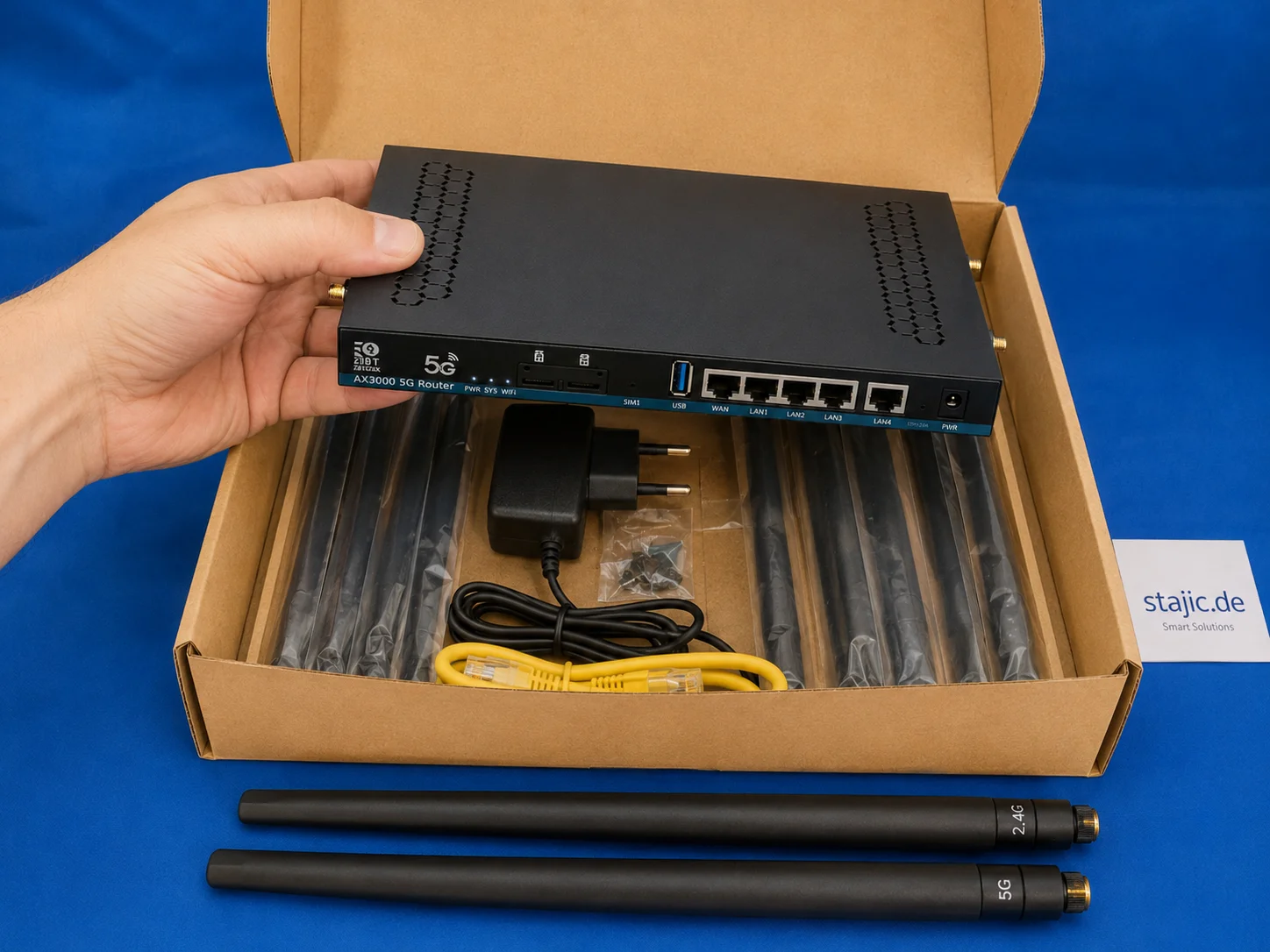
The ZBT Z8102AX makes a solid first impression as a slim black metal 5G OpenWrt router with multiple antenna connectors, dual-SIM slots, USB, LAN/WAN ports and a practical accessory set. The hardware feels useful and serious, but the packaging is clearly the weak point.

New Qwen 3.5-Plus: Open-source AI is getting serious now
Discover the groundbreaking features and benefits of Alibaba's Qwen 3.5-Plus, a revolutionary open-source AI for developers.