
How to Know Whether an AI Agent Actually Used the Right Evidence

An AI agent can cite sources, retrieve documents, and still use the wrong evidence. A source may be authoritative but irrelevant to the exact claim. A retrieved passage may support only part of an answer. A correct source can be stale, superseded, or valid for the wrong jurisdiction, product version, user, or system state. This creates a harder evaluation problem than simple citation checking: did the agent actually use the right evidence for the claim it made?
Why citations are not enough
A citation answers only a narrow question: the system associated a claim or response with a source. It does not automatically establish that the source supports the specific claim, that the source is authoritative enough for the task, that the cited passage contains the necessary condition or exception, or that the model relied on that evidence rather than producing the answer from prior model knowledge.
Anthropic's guidance for research-agent evaluation explicitly separates groundedness, coverage, and source quality. OpenAI's agent-evaluation guidance similarly emphasizes traces because a final output does not reveal whether the agent selected the right tools or followed the intended workflow. Those ideas point to a broader conclusion: evidence quality is a property of the execution path, not just the final prose.
The four questions every material claim should pass
| Dimension | Question | Typical failure |
|---|---|---|
| Claim support | Does the evidence directly support this exact claim? | The source is topically related but does not establish the statement |
| Evidence authority | Is this an appropriate source for this kind of claim? | A secondary summary is used where a primary source or live system is required |
| Applicability | Does the evidence apply to this time, version, jurisdiction, user, state, or population? | A true statement is applied outside its valid conditions |
| Evidence use | Was this evidence actually available and used in the agent's execution path? | The final answer is correct, but the retrieved evidence was irrelevant or unused |
1. Claim support: does the source establish what the agent says?
Evidence should be evaluated at claim level. A document can be relevant to the subject and still fail to support a specific statement. If a source says that a feature is available in selected regions, the answer “the feature is available globally” is unsupported even though the citation looks plausible.
This is where broad “grounded / not grounded” judgments are often too coarse. Split the response into material claims, map each claim to the smallest evidence span that supports it, and classify the relationship: direct support, partial support, contradiction, or no support.
2. Evidence authority: is this the right kind of source?
Correct evidence selection is not only semantic relevance. The source must be suitable for the decision. Current account status should come from the account system, not an old email. An API behaviour claim should preferably be checked against current vendor documentation or reproducible behaviour. A legal requirement may need the applicable law, regulator, or authoritative guidance rather than a generic blog post.
Source authority is task-specific. A community report can be the best evidence for a real-world bug that vendor documentation does not acknowledge. A vendor announcement can be authoritative for what the vendor claims but weak evidence for independent performance. The evaluator therefore needs an explicit source hierarchy for the task rather than one universal authority score.
3. Applicability: right evidence, wrong conditions
The most dangerous evidence errors are often not fabricated sources but valid sources used outside their boundary. A recommendation can change with software version, date, jurisdiction, hardware revision, user permissions, product availability, current game state, tenant configuration, or other environmental variables.
For each material source, preserve the conditions that determine whether it still applies. This is especially important after summarization: a compressed memory or citation may preserve the conclusion while dropping the exception, date, or prerequisite that made the conclusion valid.
4. Evidence use: did the agent actually rely on the evidence?
An answer can be correct even when retrieval failed. The model may already know the answer, infer it from unrelated context, or simply guess correctly. If the evaluation checks only final correctness, the system may appear well-grounded while the evidence path is broken.
To evaluate evidence use, inspect the trace. Confirm which sources were retrieved, which passages reached the model context, when they became available, and whether the final claim can be explained by those inputs. OpenAI's current agent-evaluation tooling emphasizes trace grading precisely because workflow-level behaviour cannot be reconstructed reliably from the final answer alone.
The Evidence Utilization Test
A practical evaluation can be built as a controlled counterfactual. Instead of asking only whether the answer is correct, change the evidence and observe whether the claim changes in the expected direction.
Evidence Utilization Test
A claim–evidence matrix is more useful than a source list
| Claim | Evidence | Support | Authority | Applicability | Used in trace |
|---|---|---|---|---|---|
| Feature X is available | Vendor documentation | Direct | High for availability claim | Current version and region must match | Yes / No |
| Configuration Y is faster | Vendor benchmark | Partial | High for vendor's test, not independent performance | Hardware and workload must match | Yes / No |
| Policy applies to this user | Current policy + account state | Direct only when combined | High | Jurisdiction, date, role and account state must match | Yes / No |
| A product is in stock | Live inventory API | Direct | Authoritative for current stock | Expires quickly | Yes / No |
This matrix forces several questions that conventional citation checking hides. One claim can require multiple sources. One source can support only part of a claim. An authoritative source can have a short validity window. And a perfectly good source can be irrelevant if it never entered the execution path.
Separate retrieval quality from evidence quality
Retrieval metrics ask whether relevant material was found and ranked. Evidence evaluation asks whether that material justifies the resulting claims. The two are related but not identical.
Retrieval success is not evidence success
| Situation | Retrieval | Evidence quality | |
|---|---|---|---|
| Right document, wrong claim | |||
| Right fact, stale source | |||
| Weak source, correct answer | |||
| Multiple sources required |
Evaluate source quality as a rubric, not a domain whitelist
Hard-coded lists of “trusted domains” are tempting but often brittle. Source quality should instead reflect the claim type. Useful dimensions include primary versus secondary status, recency, directness, reproducibility, independence, domain expertise, data provenance, update cadence, and whether the source has an incentive to overstate the claim.
Anthropic's research-agent evaluation guidance explicitly calls out source-quality checks alongside groundedness and coverage. The practical implementation should therefore grade both what the source says and whether this source is appropriate for this kind of statement.
Evidence coverage: every important claim needs support, not every sentence
Not every sentence needs a citation. Transitional language, arithmetic derived transparently from cited values, or clearly marked interpretation may not require a separate source. But every material externally verifiable claim should have enough support that an evaluator can reconstruct why the agent was allowed to say it.
Coverage should therefore be weighted by claim importance. Missing support for a decorative detail is not equivalent to missing support for a price, eligibility decision, safety instruction, legal requirement, technical compatibility statement, or recommendation-driving fact.
Evidence provenance must survive summarization and memory
Long-running agents often summarize previous work or write durable memories. If evidence provenance is stripped during that transformation, future agents may retrieve a clean conclusion without knowing whether it came from a user statement, a live API, an old document, a model inference, or an unverified web result.
For important facts, preserve at least the source identity, retrieval or observation time, evidence type, relevant version or state, and whether the stored text is quoted, summarized, inferred, or derived. Provenance is what allows a later agent to decide whether the evidence should be trusted, refreshed, restricted, or discarded.
A practical evidence record
| Field | Purpose |
|---|---|
| claim_id | Identifies the material claim being supported |
| source_id / source_url / system | Identifies where the evidence came from |
| evidence_span | Preserves the smallest passage, record, or tool result that supports the claim |
| retrieved_at / observed_at | Allows freshness and timeline checks |
| source_version / object_version | Allows supersession and reproducibility checks |
| authority_role | Explains why this source is suitable for this claim |
| applicability | Stores relevant date, jurisdiction, product version, user, tenant, state, or other conditions |
| transformation | Marks whether evidence is raw, quoted, summarized, normalized, or derived |
| trace_step | Shows when the evidence became available to the agent |
| support_status | Direct, partial, contradictory, unsupported, or uncertain |
Failure modes that look grounded but are not
| Failure mode | Why it fools evaluators | What to test |
|---|---|---|
| Citation decoration | The answer contains sources, so it looks researched | Map each material claim to an exact supporting span |
| Authority mismatch | The source is reputable but not authoritative for the specific fact | Define claim-specific source hierarchy |
| Temporal mismatch | The source was correct when published | Check retrieval time, source date, and superseding evidence |
| Condition stripping | A summary keeps the conclusion but drops exceptions | Compare generated claim with full local source context |
| Post-hoc citation | A plausible source is attached after the answer is generated | Inspect trace ordering and whether evidence preceded the claim |
| Parametric override | The model ignores retrieved evidence and answers from prior knowledge | Run counterfactual evidence-utilization tests |
| Evidence laundering | Model inference is summarized and later stored as if it were a source fact | Preserve transformation type and provenance across memory writes |
| Source majority fallacy | Several secondary pages repeat the same unsupported statement | Trace claims back to independent or primary evidence |
How to evaluate the agent in production
Evidence evaluation pipeline
OpenAI's current evaluation guidance recommends task-specific evals, continuous evaluation, production-derived datasets, and traces for debugging agent behaviour. Anthropic likewise recommends combining grader types for research agents because correctness, source quality, coverage, and groundedness are separate dimensions. Evidence evaluation should follow the same pattern: several narrow graders are more diagnostic than one opaque “quality” score.
Do not let an LLM judge become the only evidence judge
LLM graders are useful for scalable claim classification, relevance checks, and pairwise comparisons, but they can share the same blind spots as the system they evaluate. A grader may accept a plausible but unsupported claim, miss a subtle version boundary, or overrate a polished source.
OpenAI's evaluation guidance recommends calibrating automated graders against human judgment and using clear, scoped criteria. For evidence-heavy systems, deterministic checks should be used wherever possible: timestamps, object versions, permission scope, exact source IDs, retrieval order, document hashes, and whether the evidence was present before the model generated the claim.
What would change this answer?
The evaluation can be simpler when the agent operates over a small, immutable, authoritative corpus and every answer is strictly extractive. In that environment, source authority and applicability are mostly fixed, and claim-to-span support may be enough.
The evaluation must become stricter when the agent mixes web search, long-term memory, live tools, multiple jurisdictions, rapidly changing information, user-specific state, or autonomous actions. In those systems, evidence validity depends not only on the source text but also on when and how the evidence was obtained.
Future models may become better at internally tracking provenance and uncertainty, but that would not remove the need for external evidence records in systems that require auditability. A system should not depend on the model's self-report of what influenced it when traces and source metadata can provide stronger evidence.
Limitations
It is not always possible to prove causal evidence use from traces alone. A source can be present in context without influencing the answer, and a model may independently know the same fact. Counterfactual tests strengthen the inference but can themselves change the task distribution.
Source authority can also be contested or domain-dependent. Some questions have no single authoritative source, and experts may disagree about which evidence deserves more weight. In those cases the evaluator should preserve disagreement and score transparency, coverage, and reasoning against an explicit rubric rather than pretending there is one unquestioned source of truth.
Conclusion
The question “Did the agent cite a source?” is too weak for production AI. The stronger question is: Did each important claim come from evidence that actually supports it, has the right authority, still applies to the current conditions, and was available in the execution path before the claim was made?
That turns evidence from decoration into an evaluable system property. Capture the trace. Map claims to evidence. Check authority and applicability. Run counterfactual evidence tests. Preserve provenance through summaries and memory. Then a correct answer is not only plausible — it has an evidence path you can inspect.
FAQ
Evaluating evidence use in AI agents
Does a citation prove that an AI answer is grounded?
How can I test whether an AI agent actually used retrieved evidence?
What is the difference between groundedness and source quality?
Why can a real source still produce a wrong AI answer?
What should I log for evidence evaluation?
Glossary
Key evidence-evaluation terms
- Claim support
- The degree to which a specific evidence span directly establishes a generated claim.
- Applicability
- The conditions under which evidence remains valid for a claim, including time, version, jurisdiction, user, population, system state or other boundaries.
- Evidence utilization
- Whether the agent's output actually responds to and depends on the evidence made available in its execution path.
- Counterfactual evidence test
- An evaluation that removes, replaces or changes decisive evidence to test whether the agent's claim changes appropriately.
- Provenance
- Metadata that records where evidence came from, when it was obtained, how it was transformed and what version or state it represented.
Primary sources and further reading
OpenAI — Evaluate Agent WorkflowsGuidance on trace grading, workflow-level evaluation, datasets and repeatable eval runs for agents.
OpenAI — Evaluation Best PracticesGuidance on task-specific evals, production-derived datasets, scoped metrics, continuous evaluation and grader calibration.
Anthropic — Demystifying Evals for AI AgentsAgent-evaluation guidance including groundedness, coverage and source-quality checks for research agents.
OpenAI — A Shared Playbook for Trustworthy Third-Party EvaluationsEvaluation guidance emphasizing that modern agent performance depends on workflow and environment, not only final model output.
Related Articles

Enterprise AI Architecture: What Changes When AI Enters a Company
Enterprise AI architecture explains how AI changes company systems across data authority, identity, permissions, providers, risk, governance, evaluation, compliance and operations.

Generative AI Explained: Models, Retrieval, Tools and Applications Are Not the Same Thing
Generative AI is more than a model. Learn how models, retrieval, tools, context, runtimes and applications fit together in production AI systems.

What Is an AI Platform Architect? Models, Data, Runtime, Security and Operations
An AI Platform Architect designs reusable AI foundations across models, providers, retrieval, agents, identity, security, evaluation, observability and operations.

Should You Buy a 5G OpenWrt Router with Old Firmware? ZBT Z8102AX as a Practical Example
Buying a 5G OpenWrt router with older firmware can make sense, but only under the right conditions. The ZBT Z8102AX shows both sides clearly: the hardware is useful, the modem works, and the router stayed stable in testing, but OpenWrt 21.02, weak packaging and unclear upgrade paths require a careful buying decision.

What Is an AI Solution Architect? System Boundaries, Responsibilities and Trade-offs
An AI Solution Architect turns business requirements into a production-ready AI system across data, models, tools, security, runtime, evaluation and operations.

Computer-Use Agents: Why a Successful Demo Can Still Be an Unreliable System
Computer-use agents can now complete impressive browser and desktop workflows, but one successful run proves capability—not reliability. This article shows how to test repeatability, environmental robustness, long-horizon control, state awareness, outcome verification, and safe goal handling.

AI Governance: Models, Data, Permissions, Risk and Auditability
AI governance defines who can approve, operate, change and audit AI systems across models, providers, data, permissions, risk, evaluation and the full lifecycle.

MCP Explained: What It Connects, What It Does Not Do and Where It Fits
Model Context Protocol connects AI applications to external tools, resources and prompts through a standard client-server boundary. Learn what MCP does, what it does not do, and where it fits in agent architecture.
ZBT Z8102AX Hardware and Packaging Review: Strong Router, Weak Box
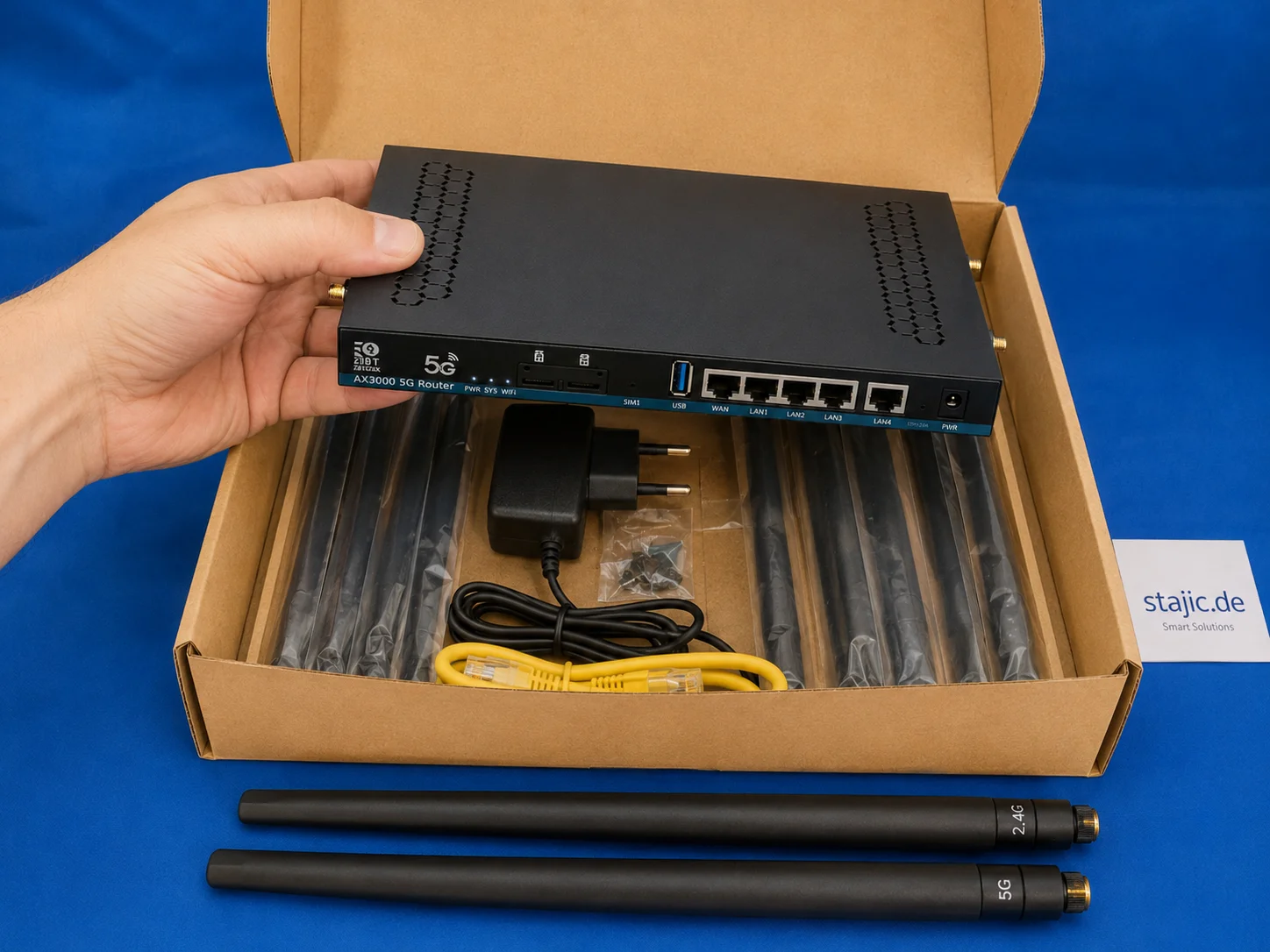
The ZBT Z8102AX makes a solid first impression as a slim black metal 5G OpenWrt router with multiple antenna connectors, dual-SIM slots, USB, LAN/WAN ports and a practical accessory set. The hardware feels useful and serious, but the packaging is clearly the weak point.

Sovereign AI: Control of Models, Data, Infrastructure and Dependencies
Sovereign AI is about effective control over models, data, infrastructure, software, operations and strategic dependencies — not simply where an AI model is hosted.

Quectel RM500U-EA in the ZBT Z8102AX: 5G Bands, o2 Germany and Real-World Signal Behavior
The ZBT Z8102AX uses a Quectel RM500U-EA modem for 4G and 5G connectivity. In the first practical test, the router connected successfully to o2 Germany with LTE Band 3 and NR n28. The modem works, but deeper diagnostics such as RSRP, RSRQ, SINR, band locking and cell behavior still need proper testing.

MCP vs A2A vs UCP vs AP2 vs A2UI: The Agent Protocol Stack Explained
MCP, A2A, UCP, AP2 and A2UI are often presented as competing agent standards. They mostly solve different interoperability problems. This guide maps each protocol to the boundary it actually standardizes—and shows how they can work together in one production system.