
MCP vs A2A vs UCP vs AP2 vs A2UI: The Agent Protocol Stack Explained
AI agent protocols are multiplying quickly: MCP, A2A, UCP, AP2, A2UI and adjacent standards increasingly appear in the same architecture diagrams. They are often described as competing protocols. In practice, most of them solve different interoperability problems at different boundaries. The useful question is not “Which protocol wins?” but “Which relationship in the system needs to be standardized?”
The core mistake: comparing protocols that sit at different boundaries
A protocol is useful because two independently implemented systems need a stable contract. The contract only makes sense if the boundary is clear. An agent talking to a database has a different interoperability problem from one agent delegating work to another, a shopper authorizing a purchase, or a remote agent asking a native application to render a form.
Google's 2026 developer guide explicitly presents MCP, A2A, UCP, AP2, A2UI and related UI protocols as a stack of complementary standards. The same example workflow can use several of them together: tools for inventory, remote agents for suppliers, commerce for ordering, payment authorization for spending and UI protocols for interaction.
The Protocol Responsibility Stack
| Protocol | Standardizes which relationship? | Primary abstraction | Not primarily for |
|---|---|---|---|
| MCP | AI application ↔ tools, resources and data | Tools, resources, prompts and host/server capability exchange | Independent agent collaboration or commerce semantics |
| A2A | Agent ↔ independent agent | Agent discovery, messages, tasks, artifacts and long-running collaboration | Direct database/tool integration |
| UCP | Consumer/agent surface ↔ merchant commerce system | Product/cart/checkout/fulfillment/order capabilities | General-purpose agent communication |
| AP2 | User/agent intent ↔ payment authorization | Mandates, approval constraints and auditable agent-led payment authority | Product discovery or generic checkout transport |
| A2UI | Agent ↔ user interface host | Declarative UI intent rendered by trusted native components | Arbitrary remote frontend code or agent-to-agent task delegation |
1. MCP: connect the agent to capabilities
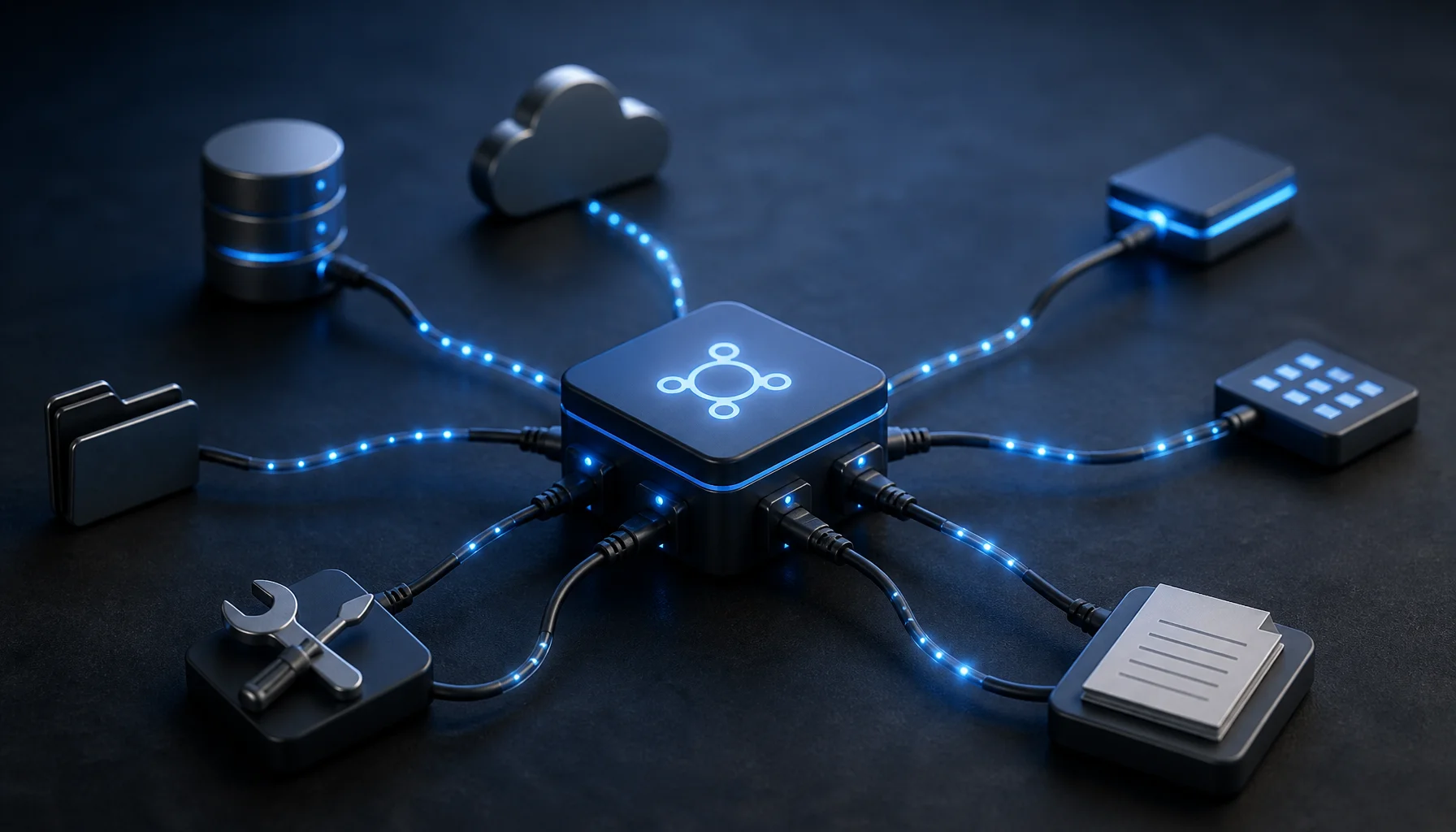
The Model Context Protocol is an open standard for connecting AI applications to external systems where tools, data and reusable resources live. A server exposes capabilities; an MCP host connects to that server and makes those capabilities available to the model or application.
The current MCP TypeScript v2 documentation describes the protocol in exactly those terms: servers expose tools, resources and prompts, while hosts such as development environments or custom applications connect to them. This makes MCP primarily a capability integration protocol.
Use MCP when
- An AI application needs standardized access to tools or APIs.
- You want one capability server to work with multiple compatible AI hosts.
- You need structured access to data or resources without hard-coding every integration into each agent.
- The external system is a capability provider, not an autonomous peer agent.
2. A2A: connect independent agents
Agent2Agent (A2A) is designed for communication between independent, potentially opaque agent systems. Its current v1.0 specification focuses on capability discovery, messaging, tasks, artifacts, multimodal content and long-running collaboration without requiring one agent to expose its internal tools, memory or implementation to another.
That opacity is the important boundary. The calling agent does not need to know whether the remote agent uses MCP, custom tools, a proprietary planner, another model vendor, or human escalation internally. It needs a contract for discovering capabilities and delegating work.
A2A v1.0 also standardizes version negotiation and supports multiple bindings around a common data model. Its published Agent Card mechanism gives clients a standard discovery point for an agent's capabilities, supported protocols, authentication requirements and skills.
Use A2A when
- One autonomous agent needs to delegate work to another autonomous agent.
- The remote system should remain opaque behind a capability contract.
- Tasks may be long-running, asynchronous or require human-in-the-loop interaction.
- Agents are built with different frameworks, languages, vendors or organizational ownership.
MCP vs A2A: vertical integration vs horizontal collaboration
MCP and A2A solve different interoperability problems
| Dimension | MCP | A2A | |
|---|---|---|---|
| Relationship | |||
| Abstraction | |||
| Internal opacity | |||
| Long-running work |
The A2A project itself now describes the distinction as horizontal versus vertical: MCP connects agents to internal tools and databases, while A2A enables peer-to-peer collaboration across agent systems.
3. UCP: standardize agentic commerce
The Universal Commerce Protocol is not a generic agent protocol. It standardizes commerce journeys between consumer surfaces, merchants and payment providers. Google's implementation already supports capabilities such as cart creation, checkout, fulfillment and order lifecycle through versioned profiles and APIs.
A merchant can publish a UCP profile under /.well-known/ucp describing services, protocol versions and capabilities. That discovery pattern matters because an agentic surface should not need a bespoke checkout contract for every merchant.
UCP is also intentionally composable. Google's technical overview says it can integrate through APIs, A2A and MCP and is compatible with AP2 for agentic payment authorization.
Use UCP when
- The workflow involves merchant products, carts, checkout, fulfillment or order lifecycle.
- You are building a merchant surface that should work with agentic shopping experiences.
- The integration needs commerce-specific semantics rather than generic tool calls.
- You want an interoperable commerce contract that can coexist with MCP, A2A and payment protocols.
4. AP2: prove that the agent was allowed to spend
Agentic commerce introduces a problem that ordinary checkout flows did not have to solve in the same way: an agent may transact when the human is not clicking the final button in real time. The Agent Payments Protocol (AP2) addresses authorization, authenticity and accountability for agent-led payments.
Google's 2026 protocol guide describes AP2 through typed mandates that capture user intent, spending constraints and the specific transaction being authorized. AP2 can work as an extension alongside UCP: UCP describes the commerce transaction, while AP2 provides evidence that the agent had authority to perform the payment.
This distinction is important. A checkout protocol can tell a merchant what should be purchased. It does not by itself prove who authorized the agent to spend, under what limit, for which merchant, for how long, or whether the final cart remained inside that authority.
UCP vs AP2: transaction semantics vs authority
| Question | UCP | AP2 |
|---|---|---|
| What is being bought? | Commerce items, cart, checkout and fulfillment semantics | References the authorized transaction context |
| Who may authorize it? | Not the primary protocol responsibility | Explicit agent/user authority and mandate model |
| What spending constraints apply? | Commerce flow can contain totals and checkout data | Authorization guardrails and intent limits |
| How is the transaction audited? | Order and commerce lifecycle | Cryptographic / verifiable authorization trail through mandates and receipts |
| Can they work together? | Yes | Yes — AP2 can extend agentic commerce flows |
5. A2UI: let agents describe interfaces without owning your frontend
Agent-to-User Interface (A2UI) tackles another boundary: how a remote or local agent communicates a rich interactive interface to a host application. Instead of sending arbitrary HTML, CSS and JavaScript, A2UI uses declarative data that the host renders through its own trusted component catalog.
This preserves the host application's design system and security model while still allowing an agent to request dynamic interfaces. A2UI v0.9 specifically emphasizes framework-agnostic UI intent and streaming updates across web, mobile and other clients.
Google's later A2UI + MCP Apps work also demonstrates that these UI models are not necessarily mutually exclusive. Declarative native UI and richer embedded application experiences can coexist depending on the task.
Use A2UI when
- A remote agent needs to request forms, cards, controls or other interactive UI.
- The host should preserve its native components, styling and security boundary.
- You do not want remote agents shipping arbitrary executable frontend code.
- The same agent-defined UI intent should work across different client frameworks.
The Protocol Selection Test
Do not start from the acronym. Start from the relationship that needs interoperability.
Choose the protocol by the boundary
A realistic multi-protocol workflow
Example: an autonomous procurement workflow
Why one universal agent protocol is unlikely to replace all of them
A universal protocol sounds simpler until it must encode every domain's semantics. Tool discovery, long-running agent collaboration, checkout, payment authorization and native UI all have different lifecycle, security and correctness requirements.
The web itself evolved through layered protocols rather than one message format for every problem. The emerging agentic stack appears to be moving in the same direction: common horizontal primitives, specialized domain contracts and explicit discovery/versioning.
The architecture challenge therefore shifts from “which protocol wins?” to how cleanly protocols compose without duplicating identity, authorization, state and audit semantics.
Protocol composition creates new failure modes
| Failure mode | What happens | Architecture control |
|---|---|---|
| Authority leakage | A valid tool or agent capability is treated as permission to perform a business action | Keep product authorization independent from protocol capability discovery |
| Identity mismatch | MCP host identity, A2A agent identity and commerce/payment identity refer to different principals | Define explicit principal mapping across boundaries |
| Version drift | One protocol upgrades while dependent adapters assume older semantics | Negotiate and pin protocol versions independently |
| State duplication | The same cart, task or approval state is copied into several protocol layers | Define one authoritative owner per domain object |
| Audit fragmentation | Tool traces, agent tasks, checkout and payment evidence cannot be joined | Carry correlation IDs and stable domain identifiers across protocol boundaries |
| Semantic tunneling | Everything is forced through a generic protocol as opaque JSON | Use domain protocols where their semantics materially improve correctness |
Protocol choice does not replace application architecture
Open standards reduce integration coupling, but they do not decide your domain model, authorization policy, source of truth, retry strategy or acceptance criteria. An MCP tool can still expose the wrong capability. An A2A agent can still return a bad artifact. A UCP checkout can still contain stale merchant data. An AP2 mandate can still be misapplied by application logic.
Treat protocols as contracts between independently evolving components. Keep domain truth and consequential policy in the application layer that owns them, then use protocols to make the boundaries interoperable.
What would change this answer?
The stack changes if protocols converge, one standard formally absorbs another, or vendors standardize a shared identity and authorization layer across several boundaries. UCP already demonstrates composition by supporting APIs, A2A and MCP and by integrating with AP2 rather than replacing them.
The answer also changes by application scope. A small internal agent may need only MCP. A multi-company workflow may need A2A. A merchant may need UCP without A2UI. A delegated purchasing agent may need all of them. Use the smallest protocol set that represents the real boundaries without flattening domain semantics.
Limitations
The protocols discussed here are at different maturity levels and have different governance models. A2A has reached a stable v1.0 specification, while other standards continue to evolve rapidly. Ecosystem adoption is also uneven across vendors and frameworks.
This article focuses on architecture responsibility rather than implementation completeness. Specific authentication methods, transport bindings, schemas and extension mechanisms must be taken from each protocol's current specification.
Conclusion
MCP, A2A, UCP, AP2 and A2UI make more sense when viewed as protocols for different relationships, not five competing attempts to standardize “agents.”
MCP exposes capabilities. A2A coordinates independent agents. UCP gives commerce its own machine-readable contract. AP2 adds verifiable payment authority. A2UI gives agents a safe declarative path into user interfaces. The emerging agentic web is therefore not replacing protocols with AI; it is creating a new protocol stack around AI.
FAQ
MCP, A2A, UCP, AP2 and A2UI
Is A2A a replacement for MCP?
Is UCP a replacement for MCP in shopping agents?
What is the difference between UCP and AP2?
What problem does A2UI solve?
Can one agent application use all of these protocols?
Which protocol should I implement first?
Glossary
Key agent-protocol terms
- MCP
- Model Context Protocol, an open standard for exposing tools, resources and prompts from external systems to compatible AI hosts.
- A2A
- Agent2Agent Protocol, an open standard for discovering and collaborating with independent agent systems through messages, tasks and artifacts.
- UCP
- Universal Commerce Protocol, an open standard for interoperable agentic commerce journeys between consumer surfaces, businesses and payment providers.
- AP2
- Agent Payments Protocol, an open standard for representing and verifying authority, intent and accountability in agent-led payments.
- A2UI
- Agent-to-User Interface, a declarative protocol for allowing agents to request UI that is rendered using the host application's trusted components.
- Protocol composition
- Using multiple protocols in one workflow, each responsible for a distinct interoperability boundary rather than forcing all semantics through one contract.
Primary sources and further reading
Google Developers — Developer's Guide to AI Agent ProtocolsA practical overview showing MCP, A2A, UCP, AP2, A2UI and related protocols working together in one multi-step agent workflow.
Model Context Protocol — TypeScript SDK v2Current stable SDK documentation implementing the 2026-07-28 MCP specification and defining tools, resources, prompts and host/server integration.
A2A Protocol — v1.0 SpecificationCurrent A2A protocol specification covering Agent Cards, messages, tasks, artifacts, bindings and version negotiation.
A2A — Joining the Agentic AI FoundationCurrent project framing of A2A as the horizontal agent-collaboration layer alongside MCP as vertical tool/data integration.
Google Developers — Under the Hood: Universal Commerce ProtocolTechnical overview of UCP, its commerce primitives and its ability to compose with APIs, A2A, MCP and AP2.
Google Universal Commerce Protocol — UCP ProfileCurrent versioned profile mechanism for publishing UCP services and merchant commerce capabilities.
Google Cloud — Agent Payments Protocol (AP2)Announcement and rationale for an open protocol covering authorization, authenticity and accountability in agent-led payments.
Google Developers — A2UI v0.9A2UI's framework-agnostic declarative model for portable agent-driven interfaces rendered by host-native components.
Google Developers — A2UI + MCP AppsHow declarative A2UI and richer MCP App experiences can coexist rather than being treated as mutually exclusive UI models.
Related Articles

Source of Truth in AI Systems: Where Reliable Knowledge Actually Comes From
A Source of Truth defines which source is authoritative for a specific fact or state. Learn how it differs from RAG, provenance, memory, context, vector databases and systems of record.
Vector Databases, Embeddings and Reranking: Three Different Parts of Retrieval
Embeddings represent meaning, vector databases retrieve candidates, and rerankers refine results. Learn how these three retrieval layers differ and work together in RAG.

What Is an AI Platform Architect? Models, Data, Runtime, Security and Operations
An AI Platform Architect designs reusable AI foundations across models, providers, retrieval, agents, identity, security, evaluation, observability and operations.
Generative AI Explained: Models, Retrieval, Tools and Applications Are Not the Same Thing
Generative AI is more than a model. Learn how models, retrieval, tools, context, runtimes and applications fit together in production AI systems.
Sovereign AI: Control of Models, Data, Infrastructure and Dependencies
Sovereign AI is about effective control over models, data, infrastructure, software, operations and strategic dependencies — not simply where an AI model is hosted.

OpenAI Agents API vs Agents SDK vs Responses API: What Should You Build On in 2026?
OpenAI’s agent stack changed in September 2026. This architecture guide separates the Agents API, Agents SDK, Responses API, and Codex SDK by runtime ownership—so teams can choose the right control boundary instead of comparing product names.

What Is RAG? The Simplest Explanation of How It Works
RAG sounds complicated, but the idea is simple: before an AI answers, it first looks up useful information from a knowledge source and gives that information to the language model. This guide explains RAG, LLMs, state, memory and tools using one simple mental model.

Enterprise AI Architecture: What Changes When AI Enters a Company
Enterprise AI architecture explains how AI changes company systems across data authority, identity, permissions, providers, risk, governance, evaluation, compliance and operations.

AI Governance: Models, Data, Permissions, Risk and Auditability
AI governance defines who can approve, operate, change and audit AI systems across models, providers, data, permissions, risk, evaluation and the full lifecycle.
MCP Explained: What It Connects, What It Does Not Do and Where It Fits
Model Context Protocol connects AI applications to external tools, resources and prompts through a standard client-server boundary. Learn what MCP does, what it does not do, and where it fits in agent architecture.

Air-Gapped AI: How AI Systems Work Without Internet or Cloud Access
Air-gapped AI runs models, RAG and AI applications inside an isolated security domain without internet or cloud dependencies. Learn how models, data, updates and tools operate offline.
Where Does an LLM Get Its Data? RAG Data Sources in Python
An LLM does not magically know your files, databases or APIs. This practical continuation of the RAG series shows, with simple Python, how external data becomes retrievable evidence: from text files and SQL to full-text search, embeddings, context assembly and the final LLM call.