
MCP Explained: What It Connects, What It Does Not Do and Where It Fits
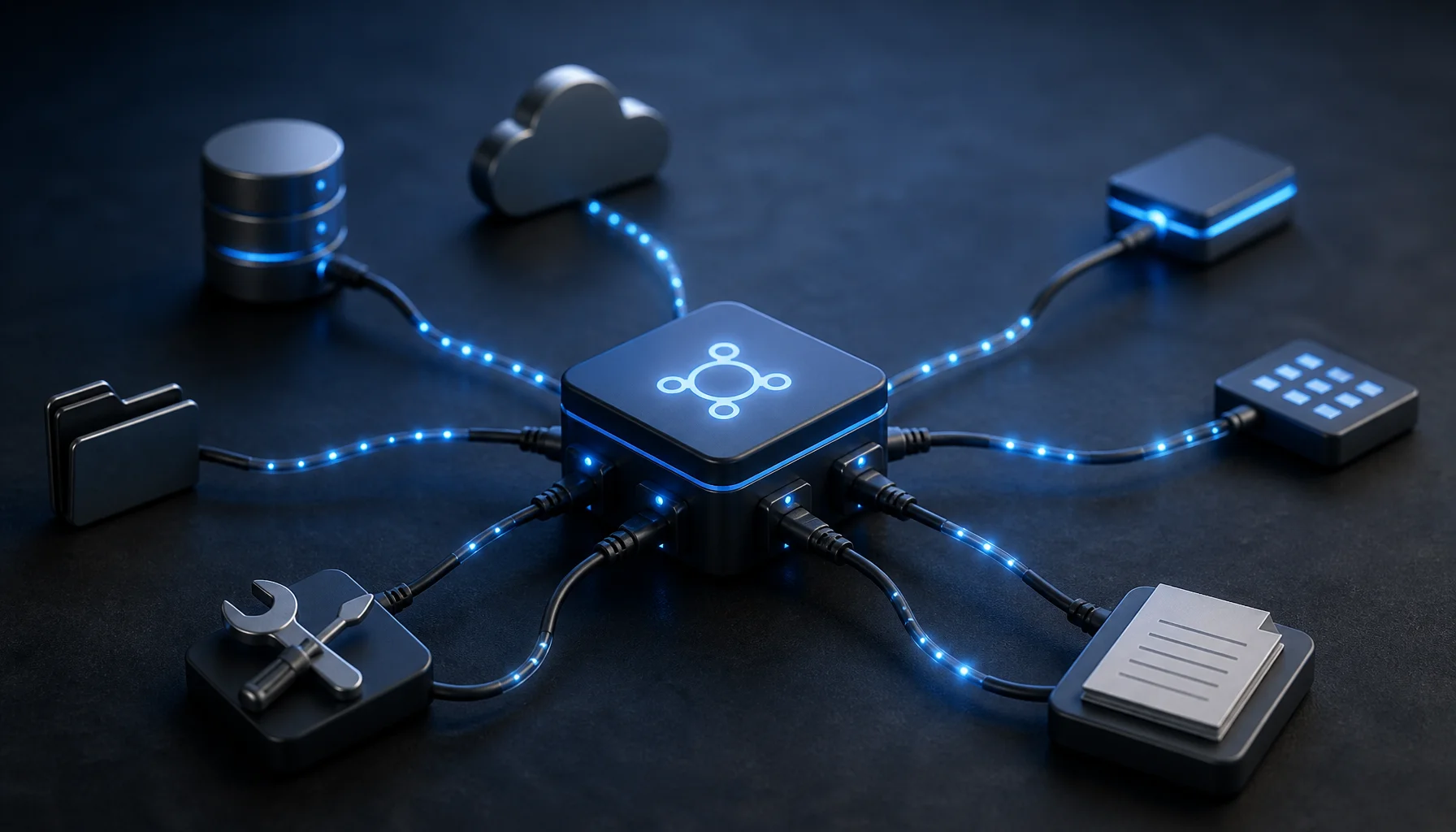
The Model Context Protocol (MCP) is an open protocol for connecting AI applications to external capabilities and information through standardized client-server contracts. An MCP server can expose tools, resources and prompts; an MCP-compatible host or client discovers and uses those capabilities on behalf of an AI application. MCP does not require the server to run its own language model, and it does not replace the agent runtime, business authorization, tenant isolation, application APIs or domain architecture behind the exposed capabilities.
What MCP really standardizes
Before MCP, every AI application could integrate external systems through its own tool schema, plugin format, authentication convention and connection code. The same service could need different adapters for a desktop AI client, an IDE agent and a custom application.
MCP creates a reusable protocol boundary. The external system exposes capabilities through an MCP server, while compatible AI hosts implement an MCP client. This reduces integration coupling between the AI application and the underlying tool or data provider.
The protocol does not standardize the entire application. It standardizes how capabilities are described, discovered and invoked across that boundary.
The simplest example
Suppose an AI coding application needs access to a local project directory. Without MCP, the application might implement its own filesystem integration directly.
With MCP, a filesystem server can expose capabilities such as listing directories, reading approved files or writing inside an allowed workspace. The AI host connects through an MCP client and presents those capabilities to the model or agent runtime.
The server does not need to understand the user's natural-language request. The host/model decides which capability is useful; the MCP server executes the structured request under its own security rules.
A basic MCP tool call
Where the simple example stops
MCP does not define how the host chooses a tool, how an agent plans, how a business workflow is modeled or how a domain object such as an invoice or deployment should behave.
A protocol can make the integration interoperable while the underlying application remains incorrect, insecure or badly designed. A perfectly valid MCP request can still call the wrong business capability.
The central boundary is: MCP standardizes integration semantics, not application truth or business correctness.
The MCP architecture: host, client and server
| Component | Responsibility |
|---|---|
| AI host | User-facing AI application or runtime that owns model interaction, context and overall workflow |
| MCP client | Protocol-side component used by the host to communicate with an MCP server |
| MCP server | Publishes capabilities and handles MCP requests |
| Underlying system | Application, API, database, filesystem, SaaS platform or service behind the MCP server |
| Model | Chooses or reasons about capabilities according to the host/runtime design; it is not necessarily inside the MCP server |
| Authorization/business policy | Determines whether a requested operation is actually permitted |
A host can connect to multiple MCP servers, and one MCP server can front one or several underlying systems. The host remains responsible for integrating MCP results into the broader AI application.
The server can be local to the host, run as a separate process or be remote over a network transport. Hosting topology and model location are independent decisions.
The three core server primitives
Tools, resources and prompts solve different needs
| Tools | Resources | Prompts | |
|---|---|---|---|
| Primary purpose | |||
| Typical interaction | |||
| Example | |||
| Typical risk |
Tools: callable capabilities
Tools are structured operations an MCP server makes available to the host. A tool has a name, description and input schema; modern implementations can also provide structured output.
Examples include searching a repository, reading a customer record, creating a ticket, running a build or sending a message. Tools can be read-only or have side effects.
A good MCP tool surface should represent coherent user or agent goals rather than mechanically mirror every internal API endpoint. Operations with different permissions, confirmation requirements or blast radius should usually be separate tools.
Resources: readable context and data
Resources expose data or content that a client can list or read. They fit naturally when the semantic operation is “give me this artifact or information” rather than “perform this action.”
A resource URI is not an authorization grant. The server still owns access control and must verify which principal may read the underlying object.
The 2026-07-28 protocol revision adds cache semantics for list and resource-read responses, including freshness and cache scope, making caching behavior more explicit.
Prompts: reusable templates
MCP prompts let a server publish reusable prompt templates to compatible clients. This can keep domain-specific instructions close to the capability provider.
A prompt supplied by an MCP server does not automatically outrank the host's system or security instructions. The host decides how prompt material enters its context hierarchy.
Protocol-provided prompt content should therefore be treated as capability data with explicit trust semantics, not as unrestricted instruction authority.
Tool or resource?
| Need | Prefer |
|---|---|
| Perform an action with structured arguments | Tool |
| Read a specific stable artifact | Resource |
| Search or calculate dynamically | Usually tool |
| Modify external state | Tool |
| Package reusable prompt instructions | Prompt |
| Long-running asynchronous execution | Tool plus application/runtime task handling or an MCP extension |
Where is the AI model?
MCP does not require the model to run on the MCP server. The model can be cloud-hosted, locally hosted, embedded in the desktop application or reached through another provider.
The host normally owns the model interaction. The MCP server exposes external capability. A local MCP server can therefore be used by a host whose model runs in the cloud, and a remote MCP server can be used by a host whose model runs locally.
If the MCP server itself calls an LLM internally, that model is part of the server's implementation behind the protocol boundary; it is not required by MCP.
MCP does not replace APIs
An MCP server often wraps existing APIs or services. REST, GraphQL, SQL, SDK calls and internal service contracts can remain exactly where they are.
MCP adds an AI-facing interoperability layer. The underlying domain API can remain the authoritative application contract for ordinary deterministic clients.
The usual architecture is therefore API/service first, selected AI-facing capability second — not “replace every API with MCP.”
MCP vs function calling
Function calling and MCP are related but not identical
| Function calling | MCP | |
|---|---|---|
| Scope | ||
| Tool definition | ||
| Portability | ||
| Can they coexist? |
OpenAI currently exposes remote MCP servers as one tool type alongside ordinary function calling, web search, shell and other tools. That implementation illustrates the architectural relationship: MCP connectivity and the model's own tool-call interface can be composed.
MCP does not create the agent loop
An AI agent needs a runtime that can decide, invoke tools, observe results, update state and continue or stop. MCP can supply some of the tools and data used by that loop.
The MCP server does not automatically become the planner, memory system or orchestrator. Those responsibilities normally remain in the host or agent runtime.
A non-agentic application can also use MCP. One deterministic MCP tool call does not require an autonomous multi-step agent.
MCP vs A2A
MCP primarily connects an AI host or agent to capabilities such as tools, resources and data. A2A targets collaboration between independent agent systems.
A remote agent can internally use MCP to reach databases and tools while exposing an A2A interface to other agents. The protocols can therefore be layered rather than substituted.
The existing protocol-stack article owns the broader MCP/A2A/UCP/AP2/A2UI comparison; G02 remains the canonical MCP definition.
Local and remote MCP use different transport realities
MCP can connect to local and remote servers. Local desktop integrations commonly use process-level transports such as stdio; remote servers use HTTP-oriented transport.
The 2026-07-28 revision makes the protocol core stateless. Requests carry the information needed for protocol handling instead of depending on the earlier protocol-level session model.
The current revision also places method and capability names in HTTP headers so gateways, WAFs, rate limiters and load balancers can route and meter MCP traffic more naturally.
Why MCP version awareness matters
| Protocol era | Operational characteristic |
|---|---|
| 2025-11-25 and earlier | Handshake/session-oriented lifecycle and older Streamable HTTP behavior |
| 2026-07-28 | Stateless core, optional server discovery, self-describing requests, routing headers, cache hints, MRTR and authorization hardening |
| Extensions | Capabilities such as Tasks and MCP Apps can version separately from the base protocol |
SDK version and protocol version are also different things. The current TypeScript v2 SDK is the stable line for the 2026-07-28 revision, while older v1.x remains a maintenance line for 2025-era behavior.
Architecture documentation should record both the SDK/library version and the protocol revision where interoperability behavior depends on them.
What changed in MCP 2026-07-28
| Change | Why it matters |
|---|---|
| Stateless core | Remote servers can scale behind ordinary load balancers without protocol-level sticky sessions |
| server/discover | Clients can inspect server capabilities when needed |
| Self-describing requests | Protocol version and client capability metadata travel per request |
| Mcp-Method / Mcp-Name headers | Gateways can route, meter and apply policy without parsing bodies |
| Cache hints | Lists/resource reads communicate freshness and sharing scope |
| Multi Round-Trip Requests | Servers can require additional input without the older bidirectional request model |
| Authorization hardening | Issuer validation and credential binding strengthen remote auth behavior |
| Extensions framework | Tasks, MCP Apps and other capabilities can evolve separately |
Roots, sampling and logging are no longer the direction for new implementations
The 2026-07-28 release marks roots, sampling and logging as deprecated protocol capabilities with a defined compatibility window.
Older tutorials may still show these features as central primitives. New implementation work should follow the current specification rather than copy older lifecycle diagrams blindly.
Deprecation does not mean immediate removal. It means new systems should avoid unnecessary new dependencies on capabilities the protocol is moving away from.
Long-running work is not the same as ordinary MCP tool invocation
Long-running operations need lifecycle semantics beyond a simple immediate tool result. In the current ecosystem, Tasks moved into a dedicated MCP extension.
This reinforces a useful design principle: the base protocol does not need to absorb every agent-runtime concern.
An application can also keep long-running workflow ownership entirely in its own runtime and use ordinary MCP tools as underlying operations.
MCP Apps extend UI capability without redefining the core protocol
MCP Apps associate richer interactive UI experiences with MCP tools through the extension model.
The host still controls how that UI is embedded, sandboxed and secured.
Core capability exchange and UI rendering should therefore remain separate architecture responsibilities.
MCP authorization is not your complete authorization model
Remote MCP needs protocol-level authentication and authorization mechanisms so clients and servers can establish trusted access. The current specification continues to harden OAuth/OIDC-related behavior.
That layer answers whether a client is allowed to connect or request protocol scopes. It does not automatically answer whether Alice may refund order 123, whether an agent may write production configuration or whether Tenant A may read Tenant B data.
Those domain decisions belong in the server/application authorization model and must be enforced before invoking the underlying operation.
Identity can cross several boundaries
An MCP request may involve the MCP client application, the signed-in human, an agent/session identity and a downstream service account.
The server needs an explicit policy for which principal the operation is performed on behalf of. Otherwise a powerful service credential can become a confused-deputy path.
For enterprise use, correlation between user identity, agent identity, MCP connection and downstream authorization is as important as protocol compatibility.
Tenant isolation remains outside MCP capability discovery
A multi-tenant MCP server must apply tenant scope when it reads or changes tenant-owned resources. Returning a tool named search_documents does not define which tenant's documents are eligible.
Tenant scope should be derived from trusted identity or membership and carried into databases, caches, vector search, object storage and downstream APIs.
Retrieving cross-tenant content and asking the model not to use it is already an isolation failure.
MCP does not define Source of Truth
An MCP server can expose a database, document repository, web search service or AI-generated summary. The protocol does not declare which source is authoritative for a claim.
Source-of-Truth rules belong to application/domain architecture. The host or server can encode authority through tool design, metadata, access policy or validation, but MCP itself does not make one capability “true.”
A tool can therefore be perfectly callable through MCP and still return stale, secondary or non-authoritative information.
MCP and context engineering
MCP can increase the capabilities and information available to an AI application, but context engineering still determines what reaches the model.
Tool catalogs consume model-visible context in many hosts. Tool results can be large. Resources can be numerous. A host needs selection, filtering, dynamic loading and compaction rather than exposing everything on every turn.
Capability availability and model-visible context should therefore be treated as separate layers.
Design MCP tools around outcomes and risk boundaries
| Weak tool design | Stronger tool design |
|---|---|
| execute_api(method,url,body) | Narrow domain tools with validated operations |
| One admin tool for all actions | Separate read/write/approval operations |
| Raw internal API mirrored 1:1 | AI-facing contract around coherent user goals |
| One broad filesystem tool | Workspace-scoped read/write operations |
| Security policy only in description | Server enforces policy in code |
| Unbounded raw response | Structured decision-relevant output |
| Delete/update mixed with read | Separate side-effect tools with confirmation policy |
Approvals belong in the execution architecture
A host can require user approval before invoking selected MCP tools. OpenAI's current MCP integration supports automatic or explicit-approval execution patterns.
Host approval is useful but should not be the server's only protection because another compatible MCP client may use a different approval model.
For destructive or financially consequential actions, use defense in depth: clear tool contract, runtime approval where appropriate, server-side authorization, business validation and audit.
MCP observability should connect protocol calls to domain actions
An MCP trace is most useful when it can be correlated with the underlying application call, database change or business transaction.
The 2026-07-28 ecosystem standardizes W3C Trace Context propagation conventions, making it easier to follow a request across host, client, server and downstream services.
Protocol logs alone are not enough for consequential operations. Audit evidence should also record relevant principal, tenant, target resource, approval and resulting state change.
What MCP cannot fix
| Problem | Why MCP does not solve it |
|---|---|
| Bad business API | MCP can expose the bad API more consistently |
| Wrong data | Protocol validity does not create factual correctness |
| Missing tenant isolation | Tool discovery does not enforce resource ownership |
| Excessive privileges | A standardized tool can still be overprivileged |
| Poor agent planning | MCP exposes capabilities; runtime/model still chooses how to use them |
| Bad retry/idempotency design | Protocol calls do not make side effects safe |
| No Source of Truth | MCP does not decide which system owns a fact |
| Weak evaluation | Interoperability does not prove task success |
| No audit policy | Transport traces do not define retention or accountability |
| Protocol mismatch | Old/new versions can still require migration or compatibility handling |
Original implementation evidence: Aaasaasa AI Client
The application can run an authenticated Streamable HTTP MCP endpoint on loopback. The endpoint exposes only directories selected through the central workspace permission broker.
The local endpoint and remote route are separate concerns: the local connector can bind only to loopback, while a Secure MCP Tunnel can make the approved MCP service reachable to a permitted external AI client without exposing the whole local machine.
The central permission model distinguishes chat-only, read-only, project-write and custom-directory profiles. Direct Chat has no filesystem or shell access; tool-capable agent runtimes use the selected permission profile.
This is a direct implementation of the G02 boundary: MCP provides the standardized capability connection, while the application-owned permission broker decides which directories the server may expose.
| Implemented element | Architecture evidence |
|---|---|
| Authenticated local MCP endpoint | MCP server can be a local deterministic capability service |
| Loopback binding | Network exposure and protocol capability are separate decisions |
| Secure MCP Tunnel integration | Private/local MCP can be bridged through a controlled route |
| Central permission broker | MCP capability is constrained by application policy |
| Selected directory scope | Filesystem visibility is explicitly bounded |
| Direct Chat without OS tools | Model access does not automatically imply tool access |
When MCP is a good fit
| MCP is a strong fit when | A direct integration may be simpler when |
|---|---|
| The same capability should be reusable across multiple AI hosts | One application owns both sides and portability has little value |
| An external system wants to publish discoverable AI-facing tools/resources | A single stable internal API call is sufficient |
| You want a standard boundary around local tools/data | There is no AI-facing interoperability requirement |
| Tool providers and AI clients evolve independently | The integration is intentionally private and tightly coupled |
| You want ecosystem-compatible capability discovery | The capability set is tiny and fixed in application code |
When you do not need MCP
Do not add MCP merely because the application uses AI. If your backend already calls one internal API and no independent MCP client needs that capability, an ordinary function or service call may be clearer.
MCP adds value at an interoperability boundary. Without that boundary, the protocol can become an unnecessary adapter layer.
The architectural question is not “Does this project have AI?” but “Do independently evolving AI hosts and capability providers benefit from a standard contract?”
MCP security checklist
| Boundary | Question |
|---|---|
| Server identity | Which MCP server am I actually connected to? |
| Client identity | Which application/client is requesting access? |
| End-user identity | On whose behalf is the operation performed? |
| Tool allowlist | Which capabilities may this host/agent discover and call? |
| Business permission | May this principal perform this operation? |
| Tenant scope | Which tenant/resource boundary applies? |
| Credential isolation | Are credentials bound correctly and kept outside model context? |
| Approval | Which side effects require human confirmation? |
| Input validation | Are tool arguments validated independently of model output? |
| Output trust | Can returned content contain untrusted instructions or sensitive data? |
| Network exposure | Is a local server accidentally exposed beyond intended interfaces? |
| Audit | Can a protocol call be correlated with the downstream action? |
Common misconceptions
| Misconception | Correction |
|---|---|
| “An MCP server is an AI server.” | It can be ordinary deterministic software exposing capabilities. |
| “I need my own LLM on the MCP server.” | No. The model can live entirely on the host side. |
| “MCP replaces REST APIs.” | MCP often wraps existing APIs for AI-facing interoperability. |
| “MCP is an agent framework.” | MCP supplies capabilities; an agent runtime manages iteration and state. |
| “MCP and function calling compete.” | A host can bridge MCP capabilities into its model tool interface. |
| “MCP replaces A2A.” | MCP focuses on capability integration; A2A focuses on agent collaboration. |
| “If a tool is listed, the user may call it.” | Discovery is not authorization. |
| “OAuth solves business permissions.” | Connection authorization does not replace domain authorization or tenant isolation. |
| “Local MCP means local AI.” | Tool-server location and inference location are independent. |
| “MCP makes tool output trustworthy.” | Data quality, authority and provenance still belong to the source/application. |
| “One giant generic tool is flexible.” | Over-broad tools weaken permissions, validation and observability. |
| “Old tutorials are implementation-current.” | The 2026-07-28 revision materially changed lifecycle and transport behavior. |
A practical MCP design sequence
Design the boundary before implementing the server
MCP architecture checklist
| Question | Expected answer |
|---|---|
| Why is MCP needed? | A real AI-facing interoperability boundary |
| What does the server expose? | Explicit tools/resources/prompts |
| Where does the model run? | Independent host/provider decision |
| Where does tool execution run? | Named server/runtime location |
| Which protocol revision is expected? | Version-aware contract |
| Who is the requesting principal? | Client/user/agent identity model |
| Which tools may be discovered? | Allowlist/capability policy |
| Which operations may execute? | Server-side business authorization |
| How is tenant/resource scope enforced? | Trusted tenant/resource ownership checks |
| Which actions need approval? | Risk-based confirmation policy |
| How are credentials protected? | Trusted runtime storage, not model-visible secrets |
| How is output bounded? | Structured relevant result contract |
| How are calls traced? | Correlation through MCP to downstream action |
| What happens if MCP is unavailable? | Defined fallback/failure behavior |
| Can another compatible host use it? | Portability validated where required |
Edge cases and limitations
A local stdio MCP server can have little network exposure while still be dangerous if the process itself has excessive filesystem or shell permissions.
A remote MCP server may expose only public documentation or highly sensitive enterprise actions. “Remote MCP” says little about risk without the capability and authorization context.
Some servers may use only tools and ignore resources/prompts. MCP compatibility does not require every optional primitive to be equally important.
A host can translate between its own internal tool model and MCP. Users may never see the protocol boundary directly, which is acceptable if security and attribution remain clear.
MCP continues to evolve rapidly. Extensions, authorization patterns, SDK APIs and ecosystem conventions can change faster than the core architectural distinction.
What would change this answer?
Future MCP revisions can change lifecycle, transports, authorization and extension mechanisms. The July 2026 revision already demonstrates why implementation-specific claims must be dated.
The canonical boundary would change only if MCP expanded from an interoperability protocol into an end-to-end application/agent architecture standard. That is not what the current protocol defines.
For implementation work, always check the current specification and exact SDK line instead of copying version-sensitive examples from older tutorials.
Related canonical knowledge
MCP belongs downstream of Agentic AI: first understand the agent/runtime/tool boundary, then use MCP when external capabilities need a portable protocol contract.
MCP also depends on RBAC and tenant isolation because protocol-level capability exposure does not determine application authorization.
The broader protocol-stack article explains where MCP sits beside A2A, UCP, AP2 and A2UI. G02 remains the canonical source for MCP itself.
Frequently asked questions
Model Context Protocol FAQ
What is MCP?
Does an MCP server need an AI model?
What is the difference between an MCP client and server?
Does MCP replace function calling?
Does MCP replace REST APIs?
Is MCP an agent framework?
What is the difference between MCP and A2A?
Does MCP handle authorization?
Can MCP work with local models?
What is the current MCP specification version?
Glossary
Key MCP terms
- MCP
- Model Context Protocol, an open protocol for interoperable connections between AI hosts/clients and external capability servers.
- MCP host
- The AI application or runtime that owns model interaction and uses MCP clients to connect to servers.
- MCP client
- Protocol component on the host side that communicates with an MCP server.
- MCP server
- Capability provider that implements MCP and exposes tools, resources, prompts or supported extensions.
- Tool
- Callable structured capability exposed by an MCP server.
- Resource
- Readable data or content exposed through MCP resource methods.
- Prompt
- Reusable prompt template exposed by an MCP server for compatible hosts.
- Streamable HTTP
- HTTP-oriented MCP transport used for remote/networked server communication.
- stdio
- Process standard-input/output transport commonly used for local MCP server integrations.
- server/discover
- Modern MCP method that lets a client inspect server capabilities in the 2026-07-28 protocol era.
- MRTR
- Multi Round-Trip Requests, a mechanism for obtaining additional input during a request in the 2026-07-28 protocol era.
- MCP extension
- Capability that composes with the base protocol and can evolve/version separately, such as Tasks or MCP Apps.
Conclusion
MCP is easiest to understand when its boundary stays narrow: it connects AI applications to external capabilities through a standard protocol.
The model does not have to live on the MCP server. The server does not become the agent runtime. A listed tool does not become an authorized business action. And MCP does not replace the underlying API, Source of Truth, tenant isolation or domain architecture.
That narrowness is the protocol's strength. MCP can standardize how AI systems reach tools and data while leaving application ownership, security, business semantics and model choice in the layers that actually own them.
Primary sources and current documentation
MCP is evolving quickly, so version-sensitive claims in this article are tied to the 8 October 2026 state. The Aaasaasa AI Client section is original implementation evidence and is explicitly limited to the verified MCP connector and permission-broker scope.
Model Context Protocol — TypeScript SDK v2Current stable TypeScript SDK documentation implementing the 2026-07-28 MCP specification and server/client primitives.
Model Context Protocol — 2026-07-28 Specification ReleaseOfficial release explanation for the current MCP protocol revision, including stateless core, MRTR, routing, caching, authorization hardening, extensions and deprecations.
MCP TypeScript SDK — Supporting protocol revision 2026-07-28Version-specific implementation guidance for the current protocol revision and earlier-era compatibility.
OpenAI — MCP serversCurrent OpenAI guidance for connecting models to remote MCP servers and local/private MCP servers through Secure MCP Tunnel.
OpenAI — MCP connections for Agents APICurrent MCP connection guidance covering service, environment and stdio locations plus allowed-tool controls.
OpenAI — ToolsCurrent overview placing remote MCP servers alongside function calling, web search, shell and other model tools.
OpenAI — MCP server conceptCurrent description of MCP servers exposing tools, resources and prompts for external service integrations.
Related Articles

What Is an AI Solution Architect? System Boundaries, Responsibilities and Trade-offs
An AI Solution Architect turns business requirements into a production-ready AI system across data, models, tools, security, runtime, evaluation and operations.
Enterprise-Grade Multi-Tenant Architecture for an International Platform
Loving Rocks is an enterprise-grade wedding platform designed with a true multi-tenant architecture, isolated databases per tenant, and built-in internationalization for global scalability, security, and long-term operational stability.
Enterprise AI Architecture: What Changes When AI Enters a Company
Enterprise AI architecture explains how AI changes company systems across data authority, identity, permissions, providers, risk, governance, evaluation, compliance and operations.
Generative AI Explained: Models, Retrieval, Tools and Applications Are Not the Same Thing
Generative AI is more than a model. Learn how models, retrieval, tools, context, runtimes and applications fit together in production AI systems.

OpenAI Agents API vs Agents SDK vs Responses API: What Should You Build On in 2026?
OpenAI’s agent stack changed in September 2026. This architecture guide separates the Agents API, Agents SDK, Responses API, and Codex SDK by runtime ownership—so teams can choose the right control boundary instead of comparing product names.
MCP vs A2A vs UCP vs AP2 vs A2UI: The Agent Protocol Stack Explained
MCP, A2A, UCP, AP2 and A2UI are often presented as competing agent standards. They mostly solve different interoperability problems. This guide maps each protocol to the boundary it actually standardizes—and shows how they can work together in one production system.
Where Does an LLM Get Its Data? RAG Data Sources in Python
An LLM does not magically know your files, databases or APIs. This practical continuation of the RAG series shows, with simple Python, how external data becomes retrievable evidence: from text files and SQL to full-text search, embeddings, context assembly and the final LLM call.

RBAC vs Tenant Isolation: Two Different Security Boundaries
RBAC controls what a user may do; tenant isolation controls which tenant’s resources that action may reach. Learn why multi-tenant SaaS security requires both boundaries.
What Is an AI Platform Architect? Models, Data, Runtime, Security and Operations
An AI Platform Architect designs reusable AI foundations across models, providers, retrieval, agents, identity, security, evaluation, observability and operations.

When Should an AI Stop Trusting Its Own Knowledge? — The Retrieval Trigger
An AI model does not need retrieval for every question. The important problem is knowing when its internal knowledge is no longer enough. The Retrieval Trigger is a practical decision boundary that determines when an AI system should stop relying solely on model knowledge and obtain external evidence before answering.

What Should an AI Agent Remember, Forget, Recompute or Retrieve Again?
Long-running agents should not remember everything. This article provides a practical lifecycle model for deciding what belongs in durable memory, what should be retrieved again, what is safer to recompute, and what should expire or be superseded.

Source of Truth in AI Systems: Where Reliable Knowledge Actually Comes From
A Source of Truth defines which source is authoritative for a specific fact or state. Learn how it differs from RAG, provenance, memory, context, vector databases and systems of record.