
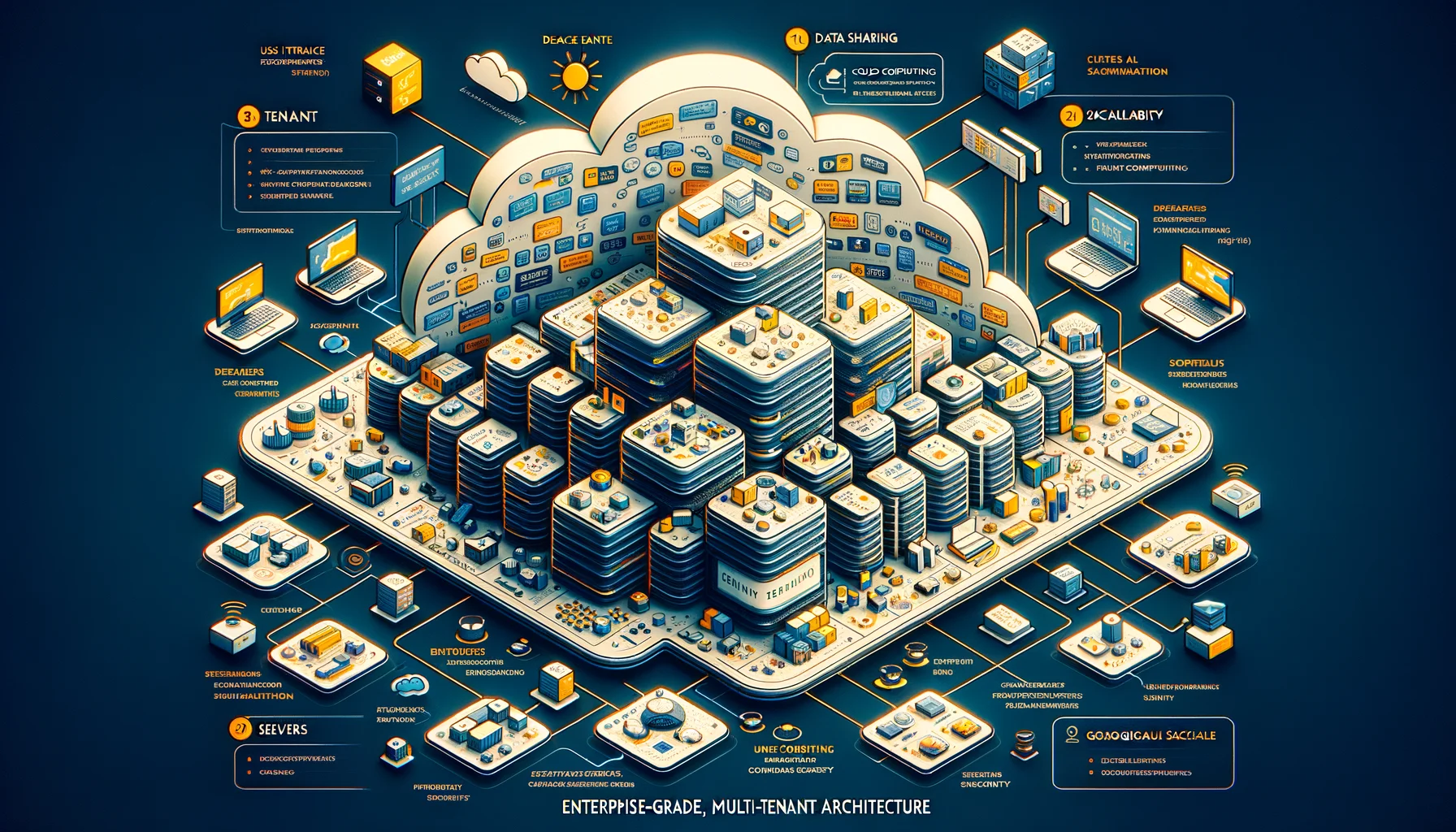
Enterprise-Grade Multi-Tenant Architecture for an International Platform
Loving Rocks
Enterprise-Grade Multi-Tenant Architecture for an International Wedding Platform
Loving Rocks is an international wedding platform engineered as a multi-tenant, multi-language, data-isolated system, designed for long-term scalability, operational stability, and market expansion. From an IT leadership perspective, the platform follows principles commonly found in enterprise SaaS architectures rather than traditional content websites.
1. Architectural Philosophy
The core architectural goal of Loving Rocks is controlled scalability without cross-tenant risk.
Instead of building a monolithic, single-database content system, the platform adopts:
- strict tenant isolation
- independent data ownership
- centralized application logic
- predictable operational behavior under growth
This allows the platform to scale across multiple domains, countries, languages, and legal contexts without structural refactoring.
2. Multi-Tenant Model (Tenant Isolation by Design)
Loving Rocks is implemented as a true multi-tenant system, not a shared-table workaround.
Key characteristics
- One database per tenant
- No shared tenant data at the persistence layer
- Tenant context resolved at request level (domain / locale / configuration)
Benefits
- Data isolation by default: a failure, corruption, or misconfiguration in one tenant cannot affect others.
- Security & compliance: tenant-specific GDPR, legal texts, and retention policies are handled independently.
- Operational flexibility: backup, restore, migration, or decommissioning can be performed per tenant without impacting others.
- Future monetization readiness: supports premium tenants, white-label deployments, and region-specific feature sets without branching the codebase.
This is the same isolation strategy used in mature enterprise SaaS platforms.
3. Data Layer Strategy
Each tenant operates on its own dedicated database.
Consequences (intentional)
- No cross-tenant joins
- No global content tables
- No accidental data leakage vectors
Structure overview
- Content schema: articles, guides, categories, tags, metadata
- Localization schema: language-normalized content, translations, locale-specific metadata
- Tenant configuration schema: domain mapping, enabled languages, branding, legal pages
This approach trades a small increase in infrastructure complexity for long-term safety and predictability.
4. Internationalization at Platform Level
Internationalization is not treated as a frontend feature, but as a core platform capability.
Current capabilities
- 8+ supported languages
- Language-aware content storage
- Localized URLs and metadata
- Market-specific legal and privacy pages
Technical implications
- Language switching does not duplicate content logic
- SEO signals (metadata, structure) are generated per locale
- New languages can be enabled without touching existing tenants
This avoids the common anti-pattern of “translated UI over single-language content”.
5. Frontend Delivery Model
The frontend is optimized for performance, predictability, and SEO stability.
Key principles
- Pre-rendered HTML for primary content
- Minimal runtime JavaScript
- No unnecessary SPA complexity
- Fully responsive layout
From a CTO perspective, this ensures consistent load times globally, low operational risk, clean separation between content delivery and business logic, and excellent search engine indexability across markets.
6. Why Multi-Tenant Architecture Matters (CTO Perspective)
For a platform intended to operate internationally, multi-tenant design is not optional.
Without it, growth introduces cross-market coupling, legal risk, operational fragility, and scaling bottlenecks.
With the chosen architecture, Loving Rocks gains:
- horizontal scalability
- regional independence
- clear ownership boundaries
- enterprise-grade maintainability
This makes the platform suitable not only for content delivery, but also for future integrations, partnerships, and white-label use cases.
7. High-Level Architecture Overview
Logical architecture layers:
┌──────────────────────────────┐
│          Frontend            │
│  (Pre-rendered, responsive)  │
└──────────────┬───────────────┘
               │
┌──────────────▼───────────────┐
│     Application Layer        │
│  - Tenant resolution         │
│  - Localization logic        │
│  - Content orchestration     │
└──────────────┬───────────────┘
               │
┌──────────────▼───────────────┐
│      Tenant Databases        │
│  - One DB per tenant         │
│  - Isolated schemas          │
│  - Independent lifecycle     │
└──────────────────────────────┘
Key design rule: A tenant is never aware of another tenant’s existence.
8. Operational Stability & Risk Management
From an operations standpoint, the platform supports:
- tenant-level rollback
- tenant-level maintenance windows
- tenant-level backups
- controlled rollout of changes
Failures are contained, observable, and reversible, which is a fundamental enterprise requirement.
Conclusion
Loving Rocks is not a traditional wedding website. It is a multi-tenant, international content platform built with enterprise architectural principles: isolated databases, language-first design, scalable backend, performance-focused frontend, and long-term operational safety.
This architecture provides a solid foundation for sustained growth, regional expansion, and future platform evolution without technical debt accumulation.
Related Articles

Ollama Is Not the Product: Building Production-Ready Open-LLM Applications
Running a local model with Ollama is easy. Building a production-ready Open-LLM application is harder: it requires RAG, access control, provider abstraction, evaluation, logging, deployment discipline and a controlled application layer around the model.

Qwen 3.6 in Production: Release Runbook, AI Rollback, and LLMOps Versioning
Qwen 3.6 is not just another model upgrade. It is a release event, a rollback scenario, and a versioning problem at the same time. This article explains how Qwen 3.6 should be handled in production through LLMOps discipline, prompt and model traceability, controlled rollout, and evidence-based rollback readiness.

Can Evidence Survive the AI Pipeline? — The Evidence Preservation Chain
Evidence can be correct at the source and still become unreliable after parsing, normalization, chunking, retrieval and context assembly. The Evidence Preservation Chain tracks whether identity, provenance, scope and meaning survive the entire AI pipeline.

Enterprise AI Architecture: What Changes When AI Enters a Company
Enterprise AI architecture explains how AI changes company systems across data authority, identity, permissions, providers, risk, governance, evaluation, compliance and operations.

What Is an AI Solution Architect? System Boundaries, Responsibilities and Trade-offs
An AI Solution Architect turns business requirements into a production-ready AI system across data, models, tools, security, runtime, evaluation and operations.

MCP Explained: What It Connects, What It Does Not Do and Where It Fits
Model Context Protocol connects AI applications to external tools, resources and prompts through a standard client-server boundary. Learn what MCP does, what it does not do, and where it fits in agent architecture.

How Far Is an AI Claim From the Evidence? — Evidence Distance
Not all supported answers are equally close to their evidence. Evidence Distance is a practical way to describe how many transformations, summaries, assumptions and inferential steps separate an AI claim from directly inspectable evidence.
A Practical Monorepo Architecture with Next.js, Fastify, Prisma, and NGINX
Explore a practical monorepo architecture using Next.js, Fastify, Prisma, and NGINX, highlighting real-world integration and workflow.

Air-Gapped AI: How AI Systems Work Without Internet or Cloud Access
Air-gapped AI runs models, RAG and AI applications inside an isolated security domain without internet or cloud dependencies. Learn how models, data, updates and tools operate offline.

When Should an AI Stop Trusting Its Own Knowledge? — The Retrieval Trigger
An AI model does not need retrieval for every question. The important problem is knowing when its internal knowledge is no longer enough. The Retrieval Trigger is a practical decision boundary that determines when an AI system should stop relying solely on model knowledge and obtain external evidence before answering.

Where Does an LLM Get Its Data? RAG Data Sources in Python
An LLM does not magically know your files, databases or APIs. This practical continuation of the RAG series shows, with simple Python, how external data becomes retrievable evidence: from text files and SQL to full-text search, embeddings, context assembly and the final LLM call.

What Is an AI Platform Architect? Models, Data, Runtime, Security and Operations
An AI Platform Architect designs reusable AI foundations across models, providers, retrieval, agents, identity, security, evaluation, observability and operations.