
The GPU Is Not the Product: Future-Proof Private AI Architecture
The discussion around local AI infrastructure often starts with the wrong question:
Which GPU should I buy?
A better question is:
Which kinds of AI workloads do I need to execute, and where should each of them run?
This distinction becomes increasingly important as AI infrastructure diverges into several very different hardware classes. A high-end consumer GPU can provide exceptional inference speed but relatively limited memory. A compact AI system can provide much more memory at lower power consumption while offering far less memory bandwidth. Edge platforms add sensor processing, real-time video and physical interfaces that conventional GPU workstations were never designed to handle.
The result is that there may no longer be one ideal AI computer. There may instead be an ideal AI execution fabric.
Different hardware solves different problems
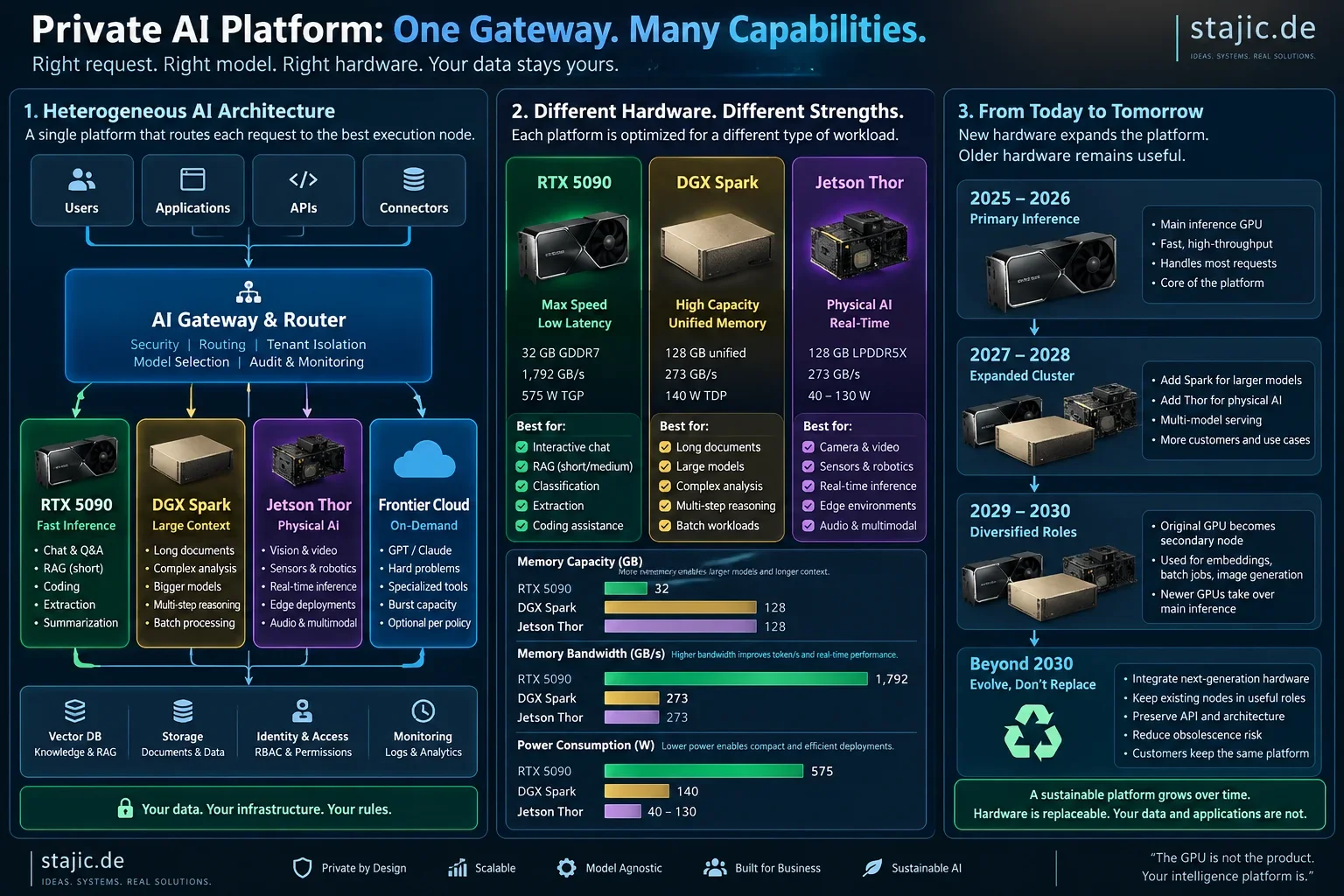
Consider several current NVIDIA platform classes. They are not simply faster and slower versions of the same machine. They represent different capability profiles.
The GeForce RTX 5090 is designed around extremely high compute throughput and memory bandwidth. With 32 GB of GDDR7 memory and very high bandwidth, it is particularly well suited to latency-sensitive inference when the model fits comfortably into GPU memory.
NVIDIA RTX 5090 specifications
DGX Spark makes almost the opposite trade-off. It combines 128 GB of coherent unified memory with 273 GB/s memory bandwidth and a relatively low power envelope. Its main advantage is not maximum token throughput but the ability to keep substantially larger models and contexts resident in memory.
Jetson AGX Thor also provides a large unified-memory architecture, but its purpose is different. It is designed for physical AI: camera streams, audio, sensor fusion, robotics and other workloads in which AI must interact with the physical environment in real time.
At the professional end of the spectrum, the RTX PRO 6000 Blackwell combines 96 GB of GDDR7 ECC memory with extremely high memory bandwidth. This class of accelerator is particularly interesting for commercial multi-tenant inference because it combines much larger memory capacity with workstation-class throughput.
Latency, capacity and physical AI
A useful infrastructure model separates workloads into three major classes.
Latency-oriented inference
Short conversations, coding assistance, classification, extraction, small RAG queries and interactive workloads benefit from high memory bandwidth and strong compute throughput. A high-end RTX system is especially suitable for this role.
Capacity-oriented inference
Large models, long contexts, large-document reasoning, batch analysis and model combinations often require far more memory than a conventional consumer GPU can provide. Systems such as DGX Spark trade raw bandwidth for a much larger unified memory pool.
Physical AI
Camera streams, audio pipelines, gesture recognition, robotics and sensor fusion require capabilities beyond ordinary LLM serving. Jetson Thor belongs in this category because compute is integrated with interfaces designed for systems operating in the physical world.
The important architectural step is therefore not choosing between these platforms. It is allowing them to cooperate.
The AI router becomes the real platform
Imagine that every application sends requests to one logical endpoint. The client does not need to know whether execution happens on an RTX workstation, a Spark node, an edge system or an external frontier model.
A routing layer can evaluate context length, modality, latency requirement, privacy policy, model capability, tenant priority and current hardware utilization before deciding where a request should run.
- A short internal FAQ request can go to a fast local model on an RTX GPU.
- A request involving hundreds of documents can be routed to a memory-rich Spark node.
- A camera or sensor workload can be dispatched to Thor.
- A particularly difficult reasoning request can optionally escalate to a frontier cloud model if the tenant policy permits it.
The infrastructure then stops being model-centric and becomes capability-centric.
That distinction matters because models change much faster than enterprise application architecture. A model used today may be replaced next year without changing the API contract used by the customer. The same is true for hardware.
A future GPU generation can simply be introduced as another execution node while the surrounding platform remains unchanged.
Multi-model serving is not the same as distributed inference
A common assumption is that an AI cluster must constantly move enormous amounts of data between every node. That is only true for certain architectures.
If one very large model is split across multiple machines, inter-node bandwidth becomes critical because tensor data must move continuously between devices.
DGX Spark therefore includes ConnectX-7 networking intended for high-speed cluster communication, including up to 200 Gb/s connectivity per supported interface.
NVIDIA DGX Spark clustering documentation
But a private AI service does not necessarily need to distribute every model. It can instead keep different models resident on different nodes.
- One node can host the fast conversational model.
- Another can host a large reasoning model.
- A third can run embeddings and reranking.
- Thor can process real-time vision, audio and sensor workloads.
In this architecture, requests and responses cross the network rather than internal model tensors. This is multi-model serving, not distributed-model inference.
For many commercial deployments, this is simpler, cheaper and easier to scale.
One cluster can serve many companies
Infrastructure capacity cannot be measured simply by the number of customer companies.
Twenty companies do not necessarily generate twenty simultaneous inference workloads. A company with thirty employees may create only a few concurrent requests during normal office work, while a single automation-heavy customer may maintain dozens of continuous agents.
The relevant capacity metrics are therefore concurrency, tokens per second, context size, requests per minute and service priority.
This creates an opportunity for statistical multiplexing: customers rarely consume their maximum contracted capacity simultaneously.
A heterogeneous cluster can therefore serve many smaller organizations while still reserving capacity for customers with stricter latency or availability requirements.
The commercial product is not GPU time
Competing directly with hyperscale GPU rental providers is difficult. Their economics are optimized around infrastructure utilization and scale.
A more defensible product is a managed private AI platform.
- Private inference
- Retrieval-augmented generation
- Tenant isolation
- Role-based access control
- Audit logging
- Model routing
- Document ingestion
- Connectors and APIs
- Evaluation and monitoring
- Dedicated or reserved capacity
The customer is not paying primarily for access to a GPU. The customer is paying for a controlled AI application layer.
Local models do not need to beat frontier AI
Another architectural mistake is treating open-weight models as direct replacements for the strongest frontier systems.
They do not need to be.
A company asking, “Which termination period is defined in this contract?” does not necessarily require the strongest general-purpose reasoning model available.
It requires reliable ingestion, correct retrieval, permission-aware access, source provenance and a sufficiently capable model.
For a large percentage of enterprise workloads, the quality of the surrounding application layer can matter as much as the underlying LLM.
The platform can therefore use local models for privacy-sensitive and high-volume workloads while reserving frontier models for the relatively small percentage of requests that genuinely require them.
This creates a form of cascaded inference: inexpensive private models process the majority of requests while more expensive capabilities are invoked only when necessary.
Future-proofing does not mean preventing obsolescence
No AI accelerator is future-proof in the literal sense. New hardware will always become faster.
The useful engineering objective is instead to reduce technological obsolescence risk.
A GPU that is the primary inference device today can later become an embedding server, batch worker, image-generation node or secondary inference pool.
A memory-rich system that once hosted the largest available model can later become a dedicated RAG, long-context or batch-analysis node.
New hardware should expand the platform rather than invalidate it.
That requires separating the execution layer from the application layer.
The durable assets are not the GPUs themselves. They are the API contracts, routing logic, tenant model, security rules, document pipelines, RAG architecture, evaluation system, observability and customer integrations.
Hardware becomes replaceable infrastructure.
The real product
The most durable private AI architecture therefore looks less like a workstation and more like a miniature cloud.
- Different hardware pools provide different capabilities.
- A scheduling layer decides where each workload belongs.
- Local models handle private and high-volume requests.
- Physical-AI hardware handles sensors and real-time environments.
- Frontier services remain available as controlled escalation paths.
- New accelerators can be introduced without forcing customers to change their applications.
From this perspective, the central question is no longer:
Which GPU should power the system?
It becomes:
Can the platform continue delivering the same service when the GPU, model or provider changes?
If the answer is yes, the infrastructure has achieved something much more valuable than simply owning fast hardware.
It has turned compute into a replaceable execution layer.
And that is where a private AI system begins to become a platform.
Related Articles

RBAC vs Tenant Isolation: Two Different Security Boundaries
RBAC controls what a user may do; tenant isolation controls which tenant’s resources that action may reach. Learn why multi-tenant SaaS security requires both boundaries.

The Answer Validity Boundary: The Missing Layer Between Relevance and Reliable AI Answers
A source can be relevant, authoritative and still be wrong for the question being asked. The missing layer is applicability: the conditions under which an answer holds, and the changes that force it to be reconsidered. This article introduces the Answer Validity Boundary as a source-design pattern for humans, AI search and RAG systems.

Sovereign AI: Control of Models, Data, Infrastructure and Dependencies
Sovereign AI is about effective control over models, data, infrastructure, software, operations and strategic dependencies — not simply where an AI model is hosted.

What Is an AI Solution Architect? System Boundaries, Responsibilities and Trade-offs
An AI Solution Architect turns business requirements into a production-ready AI system across data, models, tools, security, runtime, evaluation and operations.

AI Agent Memory Is Not RAG: How to Separate Memory, Retrieval, State and Context
Agent memory, RAG, state, and context are often used as if they were interchangeable. They are not. This practical architecture model separates the four layers, shows where each belongs, and explains what breaks when systems collapse them into one.

Agentic AI Explained: When an AI System Can Plan, Use Tools and Act
Agentic AI uses models inside multi-step execution loops where they can choose tools, observe results, update state and adapt their next action within explicit runtime and permission boundaries.
MCP Explained: What It Connects, What It Does Not Do and Where It Fits
Model Context Protocol connects AI applications to external tools, resources and prompts through a standard client-server boundary. Learn what MCP does, what it does not do, and where it fits in agent architecture.

What Is Context Engineering? What the Model Receives Before It Answers
Context engineering designs what information an AI model receives before inference, including prompts, retrieval, memory, application state, tool results and conversation history.

What Should an AI Agent Remember, Forget, Recompute or Retrieve Again?
Long-running agents should not remember everything. This article provides a practical lifecycle model for deciding what belongs in durable memory, what should be retrieved again, what is safer to recompute, and what should expire or be superseded.
MCP vs A2A vs UCP vs AP2 vs A2UI: The Agent Protocol Stack Explained
MCP, A2A, UCP, AP2 and A2UI are often presented as competing agent standards. They mostly solve different interoperability problems. This guide maps each protocol to the boundary it actually standardizes—and shows how they can work together in one production system.

What Is an AI Platform Architect? Models, Data, Runtime, Security and Operations
An AI Platform Architect designs reusable AI foundations across models, providers, retrieval, agents, identity, security, evaluation, observability and operations.

Source of Truth in AI Systems: Where Reliable Knowledge Actually Comes From
A Source of Truth defines which source is authoritative for a specific fact or state. Learn how it differs from RAG, provenance, memory, context, vector databases and systems of record.