
Portal Development: A Scalable Platform for Performance, Multilingual Support, and Extensibility
Portal Development: A Scalable Platform for Performance, Multilingual Support, and Extensibility
A modern web portal is currently being built with a focus on clean architecture, high performance, and long-term scalability. The platform is designed to deliver fast load times, a stable foundation, and a structured codebase that remains easy to maintain and extend.
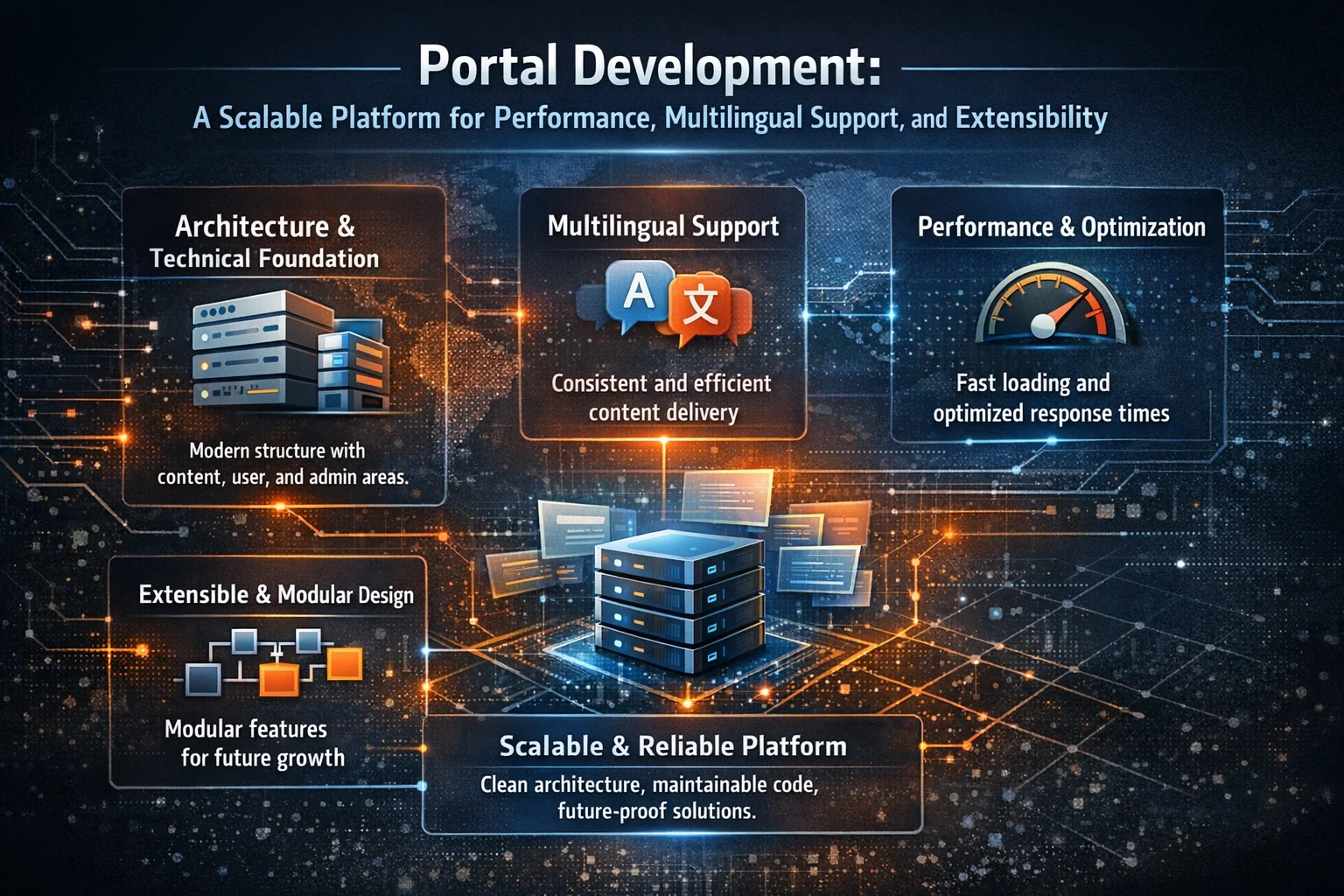
Architecture and Technical Foundation
The portal is based on a modern application structure with clearly separated areas for content, user functionality, and administrative management. The system is designed to integrate both static content and dynamic components cleanly, without unnecessary dependencies or performance trade-offs.
Multilingual Support and Structured Content
Multilingual support is a core part of the platform. Content is organized consistently, maintained in a structured way, and delivered efficiently. This provides a reliable foundation for international audiences and makes it easy to expand with additional languages without increasing complexity.
Performance and Optimization
Performance is a primary priority: optimized rendering strategies, reduced load times, and efficient data handling ensure fast response times and a smooth user experience. The technical setup is designed to deliver consistent results across desktop and mobile devices, even as traffic and feature requirements grow.
Extensibility and Modular Growth
The portal follows a modular approach, allowing features such as authentication, customer areas, admin tools, and additional services to be added at any time. The core remains stable and maintainable, ensuring that future expansions can be implemented in a controlled and scalable way.
Goal
This portal is positioned as a professional platform that combines technical quality, maintainability, and scalability. Clear structures, clean implementation, and a future-proof architecture create a strong foundation for continuous improvement and reliable long-term operation.
Related Articles

When Should an AI Stop Trusting Its Own Knowledge? — The Retrieval Trigger
An AI model does not need retrieval for every question. The important problem is knowing when its internal knowledge is no longer enough. The Retrieval Trigger is a practical decision boundary that determines when an AI system should stop relying solely on model knowledge and obtain external evidence before answering.

Enterprise AI Architecture: What Changes When AI Enters a Company
Enterprise AI architecture explains how AI changes company systems across data authority, identity, permissions, providers, risk, governance, evaluation, compliance and operations.

Ultimate Guide to Acceptance Criteria for LLM Adoption in Enterprise Playbooks
Master the art of defining precise acceptance criteria to ensure successful LLM integration in your enterprise environment. This comprehensive guide provides actionable frameworks, examples, and best practices tailored for playbook-driven adoption.

Managed Agent Harness vs Self-Hosted Agent Loop: What You Gain, What You Lose
“Self-hosted agent” can mean very different architectures. This guide separates the managed harness, self-hosted execution environment, and fully self-operated agent loop—and shows which control boundary teams actually need.

Google I/O 2026: Gemini Omni, Gemini 3.5, and the Compute Layer Behind Agentic AI
Google I/O 2026 put Gemini Omni and Gemini 3.5 at the center of Google’s agentic AI strategy. This article breaks down the difference between multimodal creation and action-grade intelligence, why Gemini 3.5 Flash matters for agents and coding, and how these models power the wider Google I/O 2026 platform shift.

Generative AI Explained: Models, Retrieval, Tools and Applications Are Not the Same Thing
Generative AI is more than a model. Learn how models, retrieval, tools, context, runtimes and applications fit together in production AI systems.

AI Agent Reliability: Why the Final Answer Is Not Enough
Correct output does not prove correct reasoning, safe execution, or a trustworthy system.

The GPU Is Not the Product: Future-Proof Private AI Architecture
Private AI infrastructure should not be designed around one GPU or one model. A more resilient approach combines fast inference GPUs, memory-rich AI systems, physical-AI nodes and optional frontier cloud models behind a capability-aware routing layer.

ADR vs NFR: Architecture Decisions and System Quality Are Not the Same Thing
ADR vs NFR explained: learn how system quality requirements drive architecture decisions, how ADRs record trade-offs, and why validation stays separate.

Should You Buy a 5G OpenWrt Router with Old Firmware? ZBT Z8102AX as a Practical Example
Buying a 5G OpenWrt router with older firmware can make sense, but only under the right conditions. The ZBT Z8102AX shows both sides clearly: the hardware is useful, the modem works, and the router stayed stable in testing, but OpenWrt 21.02, weak packaging and unclear upgrade paths require a careful buying decision.

Enterprise-Grade Multi-Tenant Architecture for an International Platform
Loving Rocks is an enterprise-grade wedding platform designed with a true multi-tenant architecture, isolated databases per tenant, and built-in internationalization for global scalability, security, and long-term operational stability.

Ollama Is Not the Product: Building Production-Ready Open-LLM Applications
Running a local model with Ollama is easy. Building a production-ready Open-LLM application is harder: it requires RAG, access control, provider abstraction, evaluation, logging, deployment discipline and a controlled application layer around the model.