
Model-View-Controller (MVC): The Structural Backbone of Modern Web Applications
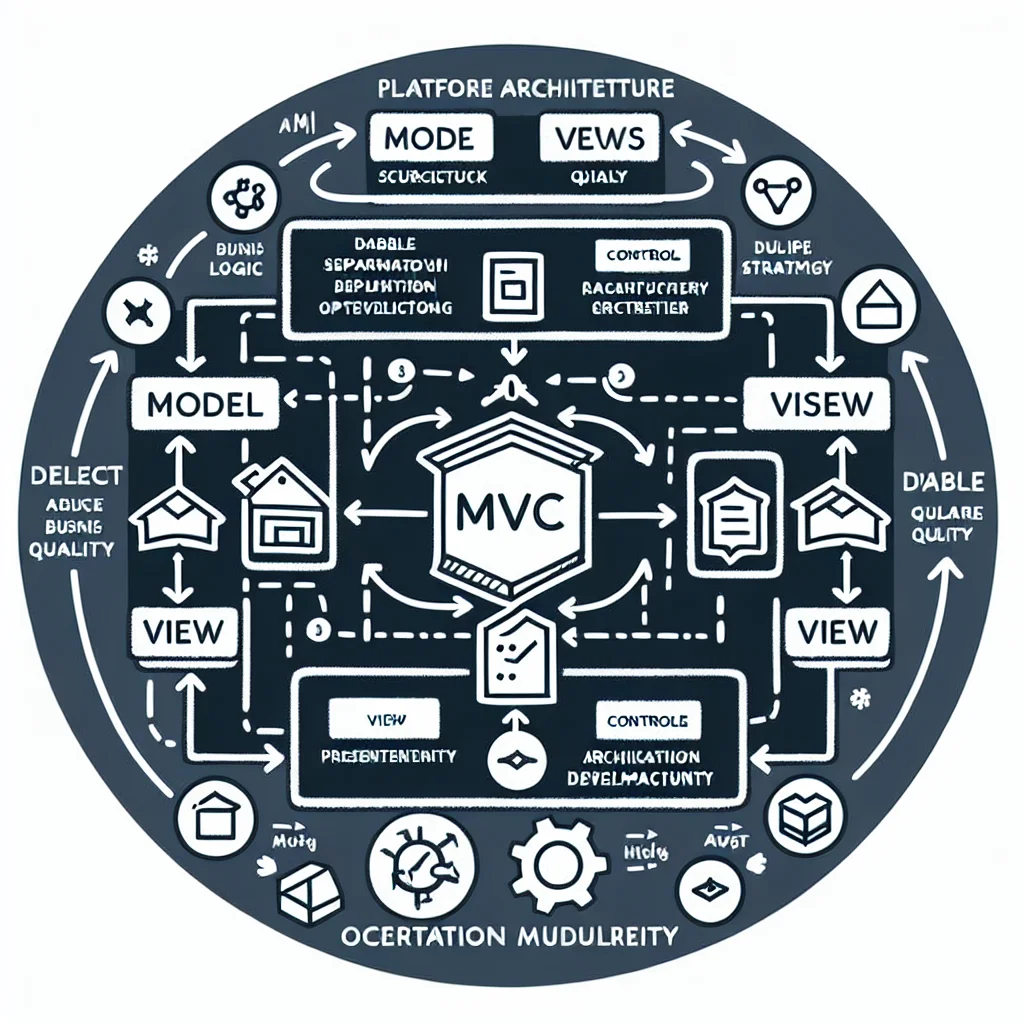
The Model-View-Controller (MVC) pattern remains one of the most durable foundations in web application architecture. Its longevity is not an accident. MVC survives because it solves a problem that never really disappears: how to structure software so that growth does not turn every change into risk. When responsibility is separated well, teams can extend features, revise interfaces, refactor internals, and release changes with far less friction.
That is why this topic belongs naturally inside Enterprise Delivery OS. MVC is not just a coding convention. It is a structural discipline that influences platform maintainability, delivery safety, migration effort, test design, and operational clarity. In practical engineering terms, MVC is useful because it draws boundaries where systems usually become tangled.
Within the stajic.de pillar structure, the strongest primary fit is Reference Models > Digital Platform. MVC is first an architecture and platform-boundary topic. It also connects to delivery and change, migration and replatforming, release control, and delivery assessment, but those are secondary supporting relationships rather than the main classification.
What MVC Actually Separates
MVC divides an application into three different areas of responsibility. The Model represents domain state, invariants, and rules. The View is responsible for presentation and interaction output. The Controller receives requests, coordinates the relevant use case, and decides how the response should be assembled. The names are simple, but the value is significant: clean separation reduces hidden coupling.
- The Model owns domain meaning, not just storage.
- The View presents information clearly, without quietly becoming the business layer.
- The Controller coordinates flow, instead of turning into a god object.
Once those boundaries weaken, systems become harder to understand. Business rules drift into templates. Controllers become overloaded with orchestration, validation, and side effects. Models become passive database wrappers. Teams then mistake framework structure for architectural clarity, even though the codebase is already entangled.
Why MVC Still Matters in Modern Web Stacks
Modern frameworks often speak a different language: components, composables, islands, server actions, API routes, headless delivery, and edge rendering. None of that removes the need for separation. It only redistributes where separation must happen. A serious platform still needs a stable place for domain rules, a controlled path for request orchestration, and a presentation layer that does not secretly own policy.
That is why the useful question is not whether a framework calls itself MVC. The useful question is whether the platform protects the same boundaries that MVC was designed to enforce. If it does not, then the stack may look modern while still accumulating structural debt.
Framework novelty does not replace architectural discipline. New syntax can hide old chaos.— Platform architecture perspective
A Minimal Request Flow
The simplest way to understand MVC is to follow a request through the system. A user requests a page or triggers an action. The controller receives the request, delegates domain work to models or services, prepares a response structure, and passes the result to the view. The view renders the output. This flow is easy to explain, but many systems violate it in practice.
// Request enters the system
GET /products/42 // Router chooses the controller action
ProductController.show(id = 42) // Controller coordinates the use case
product = ProductService.getById(42)
viewModel = ProductPresenter.toViewModel(product) // View renders output
return render("product/show", viewModel)
This example is intentionally minimal. The value is not the syntax. The value is visibility. A reviewer can see where the request enters, where domain work happens, and where presentation begins. That clarity becomes extremely important when teams are changing a live platform under delivery pressure.
What the Model Should Really Own
In weak implementations, the model becomes little more than an ORM entity or database record. That is too narrow. A useful model protects business meaning. It should hold rules that must remain true regardless of whether the request came from a web form, an admin screen, a public API, a background worker, or a CLI job.
- State transitions such as allowed status changes
- Invariants that must hold across every interface
- Domain-level validation that belongs to the business, not only to the form layer
- Calculated values and decisions that represent actual business behavior
class Order: def cancel(self, actor): if self.status == "shipped": raise DomainError("Shipped orders cannot be cancelled") if not actor.can("cancel_order"): raise PermissionError("Actor may not cancel this order") self.status = "cancelled"That rule is small, but the lesson is large. If a rule matters, it needs a stable home. When such logic exists only in one controller action or one UI form, another path will eventually bypass it. Domain rules should live where the domain can actually defend them.
What the View Should and Should Not Do
The view exists to present information, format output, and support interaction. It can contain display logic, but it should not become the hidden owner of important business policy. Once templates start deciding who is allowed to do what, the system becomes harder to test, harder to audit, and easier to break.
<!-- Good: presentation logic -->
{% if product.stock > 0 %} <button>Add to cart</button>
{% else %} <p>Currently unavailable</p>
{% endif %} <!-- Bad: business policy leaking into the template -->
{% if user.role == "admin" or order.total < 1000 or region == "DE" %} <button>Approve refund</button>
{% endif %}
A view may decide how to display a state. It should not silently decide which policies are valid. That distinction looks small in code review, but it becomes huge over time.
Controllers Should Coordinate, Not Accumulate Power
Controllers are useful because they create a clear entrance into the application. But they should stay focused. A controller that validates raw input, calls external services, calculates domain decisions, transforms persistence data, and decides final rendering strategy is no longer just a controller. It becomes a hidden application layer welded to HTTP.
// Too much responsibility in one controller
async function checkout(req, res) { validateCart(req.body) const tax = await taxApi.calculate(req.body.address, req.body.items) const discount = computeDiscount(req.user, req.body.items) const inventory = await reserveItems(req.body.items) const payment = await chargeCard(req.body.card) const order = await db.orders.create({ tax, discount, inventory, payment }) res.render("checkout/success", { order })
}
// Better: controller delegates to application services
async function checkout(req, res) { const command = CheckoutCommand.fromHttp(req) const result = await checkoutService.execute(command) res.render("checkout/success", CheckoutPresenter.toViewModel(result))
}This is where MVC becomes strongly relevant to delivery quality. Clear boundaries reduce review scope, shrink change impact, and make releases easier to reason about. That is also why MVC relates naturally to the Delivery and Change Reference Model, which focuses on shipping changes safely with explicit evidence and measurable outcomes.
MVC and Platform Architecture
The best primary fit for this article is the Digital Platform Reference Model. That page describes a tech-agnostic structure for designing and operating a digital platform at scale. MVC fits there because it is part of the structural vocabulary teams use to define boundaries, responsibilities, and change surfaces inside real systems.
A platform with weak internal boundaries may still run in production, but it becomes slower to evolve. New features take longer. Bugs become harder to localize. Refactoring gets postponed. Releases carry more unknown risk. In that sense, MVC is not merely about code style. It is about preserving changeability.
MVC in Modern Frameworks and Headless Systems
Not every modern stack exposes classic MVC directly. In SSR frameworks, controllers may appear as route handlers or server actions. In API-first systems, the view may live in a separate frontend. In headless platforms, model behavior may be split across services, domain modules, and persistence layers. But the need for separation does not vanish. It simply spreads across more moving parts.
- SSR frameworks often move controller logic into route-level handlers
- API-first architectures place presentation in a distinct frontend layer
- Headless systems distribute model behavior across service and domain boundaries
- Component-based UIs still benefit from keeping business policy out of the view layer
So the deeper lesson is this: MVC remains valuable even when its classical packaging disappears. It survives as a design principle because responsibility separation remains one of the few reliable defenses against entropy.
Why MVC Makes Replatforming Easier
Legacy migrations often fail because the old platform mixed everything together. Queries live in templates. State transitions hide in helper files. Validation is duplicated in forms, APIs, and admin tools. Nobody can move one part safely because too many responsibilities are fused together. The cleaner the separation, the more realistic the migration path becomes.
That is why MVC has strong secondary relevance for the Migration and Replatform Playbook. Replatforming is not only a technology replacement exercise. It is a disentangling exercise. Teams must expose and stabilize responsibility boundaries before a move can become safe.
Replatform-safe sequence
1. Move domain rules out of templates and controllers
2. Reduce controllers to request mapping and orchestration
3. Introduce presenters or view models for stable output contracts
4. Isolate persistence access behind services or repositories
5. Migrate one boundary at a time instead of rewriting everything at once
This kind of restructuring does not make migration trivial, but it reduces uncertainty. That alone can save months of waste.
Release Safety, Testing, and Operational Confidence
MVC does not guarantee safe releases by itself, but it makes release safety much easier to achieve. Thin controllers, explicit services, stable view models, and protected domain rules make it clearer where a change really lands. That improves review quality, narrows the blast radius of mistakes, and helps teams design tests at the correct layer.
- Model tests verify invariants and business rules
- Service tests verify use-case behavior
- Controller tests verify request mapping and response flow
- View tests verify rendering and interaction expectations
- End-to-end tests protect key user journeys without carrying the entire burden
This is why MVC also connects naturally to the Release Runbook and the Delivery Assessment. A platform with explicit structure is easier to release, easier to measure, and easier to improve.
Release-safe change pattern
1. Update the domain rule in one trusted place
2. Extend service or use-case tests
3. Adjust controller mapping only if the request contract changed
4. Update presenter or view model only if the output contract changed
5. Verify affected screens and API responses
6. Release with rollback awareness and clear evidence
Common MVC Anti-Patterns
- Fat controllers that secretly contain the application layer
- Passive models with no meaningful domain behavior
- Views that make hidden policy decisions
- Duplicated validation across frontend, backend, and admin tools
- No stable presenter or view-model boundary between domain and UI
- Framework conventions mistaken for architecture
These problems often appear gradually, which is why teams underestimate them. A codebase can look organized from the outside and still be structurally weak inside.
A framework can generate folders. It cannot generate good boundaries. Those still have to be designed and defended by the team.— Enterprise Delivery OS perspective
Best-Fit SEO Pillar Placement
Inside the Enterprise Delivery OS structure, this article belongs to Reference Models > Digital Platform. That is the correct primary placement because MVC is fundamentally about platform structure and responsibility boundaries. Its secondary support links belong to Delivery and Change, Migration and Replatform, Release Runbook, and Delivery Assessment.
That placement is not cosmetic. It tells the portal, the editor, and the reader where the topic belongs structurally. MVC is not mainly a release checklist, not mainly a migration tactic, and not mainly an assessment rubric. It is first a platform design principle.
Final Perspective
Model-View-Controller remains relevant because software does not become easier merely because frameworks become newer. Teams still need a stable place for domain rules, a controlled path for request handling, and a presentation layer that does not smuggle policy into the interface. Used well, MVC becomes more than a historical pattern. It becomes a practical instrument for cleaner architectures, safer releases, easier migrations, and stronger long-term delivery discipline.
Enterprise Delivery OSEnterprise knowledge base for platform, delivery, security, and LLM adoption.
Digital Platform Reference ModelA tech-agnostic structure for designing and operating a digital platform that supports product delivery at scale.
Delivery and Change Reference ModelThis model defines how to ship changes safely with quality gates, clear evidence, and measurable outcomes.
Migration and Replatform PlaybookPlaybook for reducing migration risk and structuring safer replatforming work.
Release RunbookRunbook for preflight checks, release steps, verification, and post-release review.
Delivery AssessmentAssessment for delivery capability, change risk, and release discipline.
Related Articles
Canonical Architecture, URL Design, Resolver Logic, API & Scalability Specification
Geo-based discovery architecture for multi-tenant portals. Defines canonical URLs, resolver logic, caching strategy, and a geo read-model without CMS coupling or database refactoring. Designed for SEO stability, scalability, and future extensions like booking and maps.

Ollama Is Not the Product: Building Production-Ready Open-LLM Applications
Running a local model with Ollama is easy. Building a production-ready Open-LLM application is harder: it requires RAG, access control, provider abstraction, evaluation, logging, deployment discipline and a controlled application layer around the model.

Qwen 3.6 in Production: Release Runbook, AI Rollback, and LLMOps Versioning
Qwen 3.6 is not just another model upgrade. It is a release event, a rollback scenario, and a versioning problem at the same time. This article explains how Qwen 3.6 should be handled in production through LLMOps discipline, prompt and model traceability, controlled rollout, and evidence-based rollback readiness.
Enterprise-Grade Multi-Tenant Architecture for an International Platform
Loving Rocks is an enterprise-grade wedding platform designed with a true multi-tenant architecture, isolated databases per tenant, and built-in internationalization for global scalability, security, and long-term operational stability.