
PostfixAdmin: Enterprise-Grade Management for Postfix Mail Systems — Anno 2026
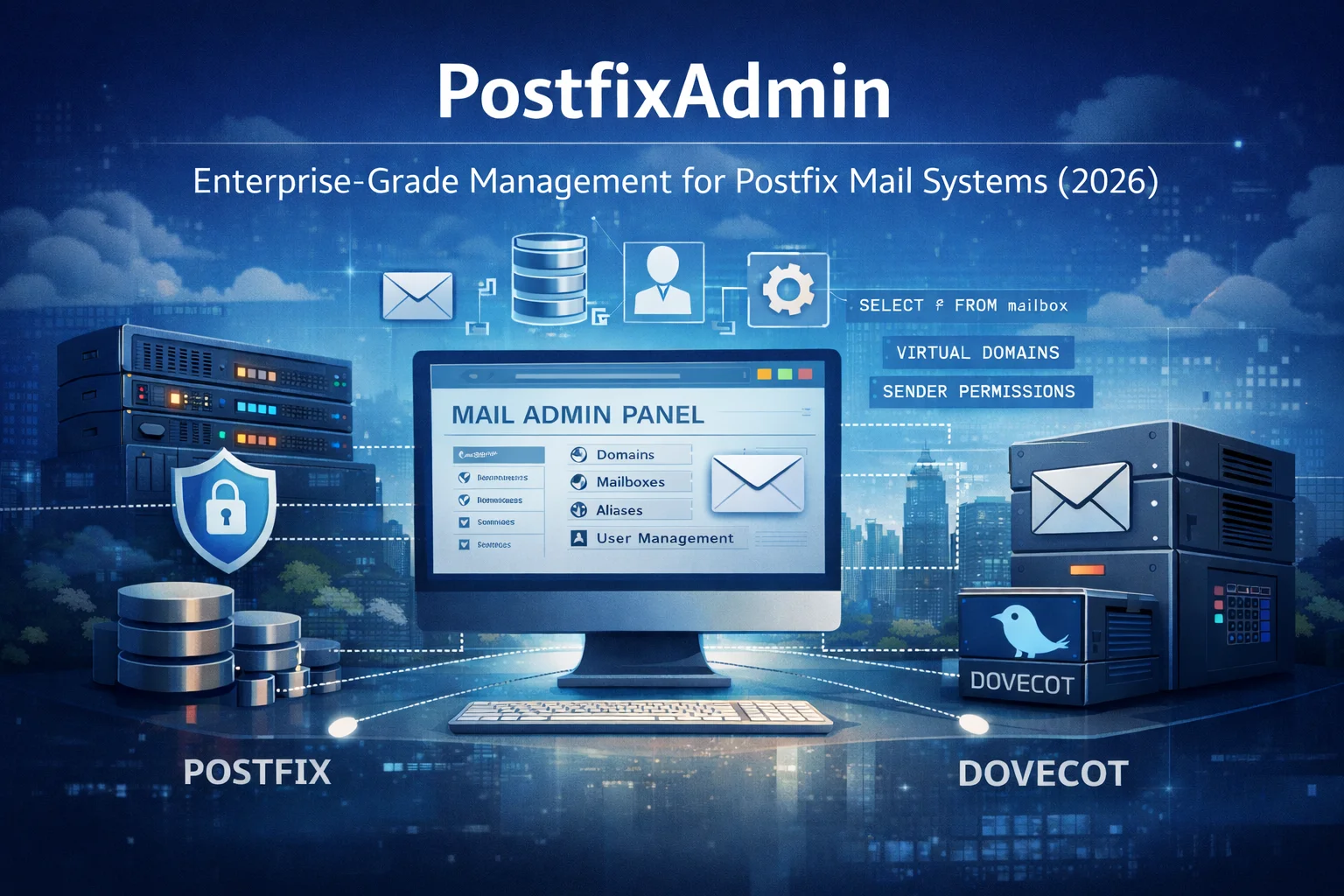
PostfixAdmin: Enterprise-Grade Management for Postfix Mail Systems (2026)
PostfixAdmin is a database-centric administration interface designed for professional Postfix mail infrastructures. This article explains why it remains relevant in 2026, how it integrates with Postfix and Dovecot, and how to deploy it correctly in enterprise environments.
Why PostfixAdmin in 2026?
PostfixAdmin stands out in the modern MTA ecosystem as a lightweight yet powerful interface for managing domains, mailboxes, aliases, quotas, and transports. In contrast to heavier groupware suites like Zimbra or iRedMail, PostfixAdmin is modular and can integrate with your own Postfix, Dovecot, SpamAssassin, and Roundcube stack — with full control over mail logic and policies.
- Self-hosted, PHP-based UI for mail admins
- MySQL/MariaDB/PostgreSQL backend
- Manages domains, mailboxes, aliases, transports, quotas
- Supports password encryption (SHA512-CRYPT, MD5, etc.)
- Admin roles and per-domain delegation
- Vacation auto-responders (via Dovecot Sieve)
How To Install PostfixAdmin
Below is a basic installation workflow, assuming a Debian/Ubuntu system and a standard LAMP setup.
# Install dependencies
sudo apt install php php-mbstring php-intl php-imap php-mysql php-cli php-common php-curl php-xml unzip mariadb-server apache2

# Download and extract PostfixAdmin
curl -LO [https://github.com/postfixadmin/postfixadmin/archive/refs/heads/master.zip
unzip](https://github.com/postfixadmin/postfixadmin/archive/refs/heads/master.zip
unzip) master.zip
mv postfixadmin-master /var/www/postfixadmin

# Set permissions
sudo chown -R www-data:www-data /var/www/postfixadmin

# Configure database
mysql -u root -p <<EOF
CREATE DATABASE postfixadmin CHARACTER SET utf8mb4 COLLATE utf8mb4_general_ci;
CREATE USER 'postfixadmin'@'localhost' IDENTIFIED BY 'strong_password';
GRANT ALL PRIVILEGES ON postfixadmin.* TO 'postfixadmin'@'localhost';
FLUSH PRIVILEGES;
EOF
Then configure the application:
# Copy config template
cp config.inc.php.sample config.inc.php

# Edit config
nano config.inc.php
Access the web installer at [https://yourdomain.tld/postfixadmin/public/setup.php](https://yourdomain.tld/postfixadmin/public/setup.php) and follow the instructions. Set up your setup password hash in config, then generate admin user.
Integrations
PostfixAdmin is not just a pretty face. It integrates with:
- Postfix – via SQL transport_maps, virtual_mailbox_maps, virtual_alias_maps
- Dovecot – manages user mailboxes and passwords via SQL
- Roundcube – webmail access to user inboxes
- SpamAssassin/Rspamd – per-user spam preferences (optional)
Why It Matters
With proper SQL integration, PostfixAdmin lets you build multi-domain, multi-admin mail clusters with per-domain delegation. It fits well into automation tools like Ansible or Terraform by serving as the persistent backend for mail policies.
Its future-proof, database-first architecture makes it far more maintainable than hand-written aliases or flat-file maildir setups, especially when scaling beyond a dozen domains.
Conclusion
PostfixAdmin remains one of the most elegant and effective ways to manage virtual mail hosting using Postfix. Whether you're managing a small VPS or building an enterprise mail cluster, its SQL-driven logic and extensibility ensure that your infrastructure is both stable and scalable.