The Complete Technical Overview of the Custom Nuxt 4 AI-Powered CMS Platform
This CMS ecosystem is not a typical WordPress setup, not a generic headless builder,
and not just another Nuxt project. It is a fully engineered, high-performance AI-powered
platform built on Nuxt 4, designed for speed, automation, scalability, and deep
integration with modern AI technologies.
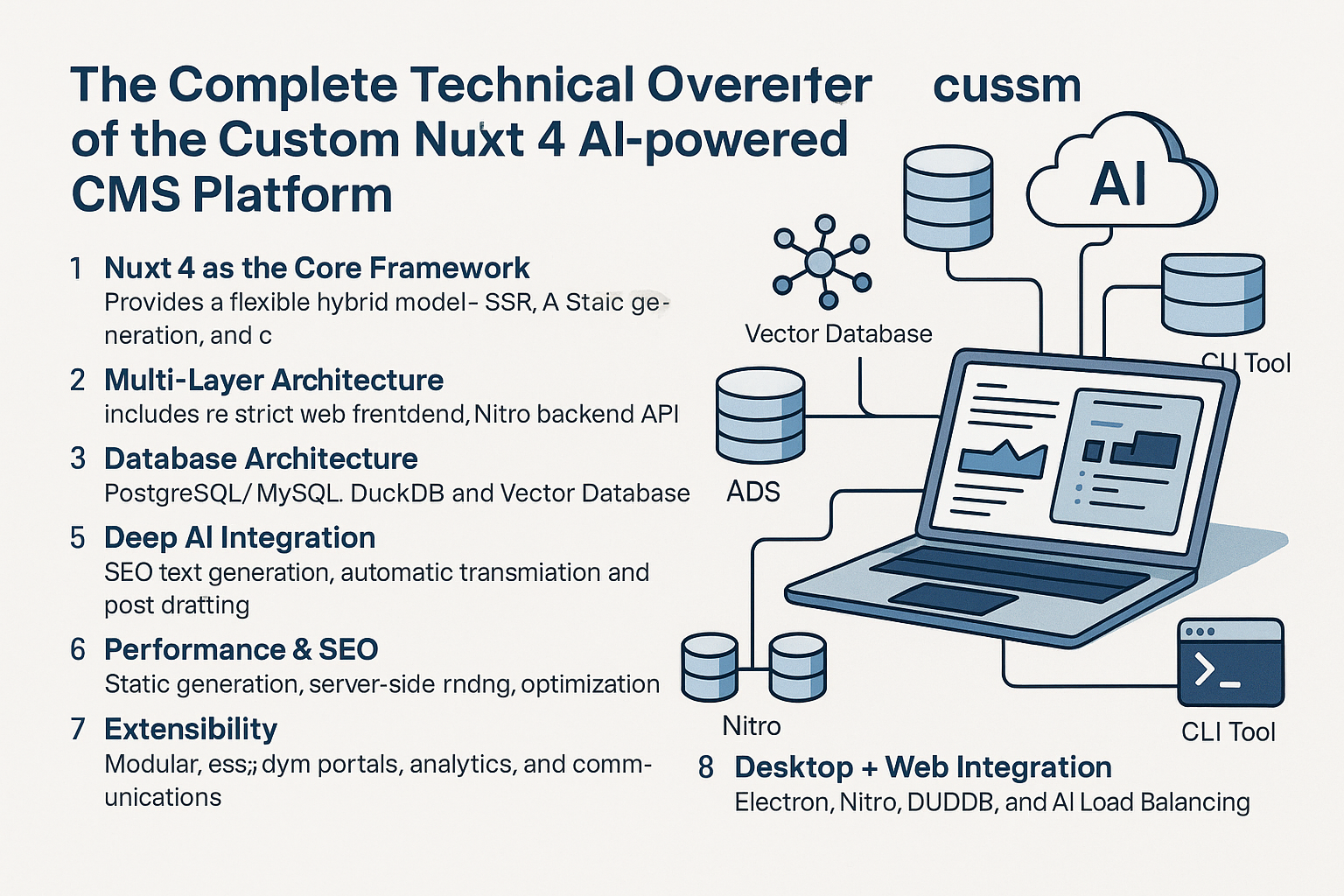
1. Nuxt 4 as the Core Framework
The system uses Nuxt 4 as its foundation because it provides a flexible hybrid model:
SSR, SPA, and static generation in one framework. Combined with TypeScript, TailwindCSS,
Nitro, and a modular monorepo structure, it enables a clean separation between:
- Web Frontend – public website / client-facing pages
- Admin Panel – a dedicated dashboard for managing content and system settings
- Nitro Backend – a full API layer used by both apps
2. Multi-Layer Architecture
The system consists of three independent but connected layers:
2.1 Web Frontend
The frontend is fast, SEO-optimized, multilingual, and built with reusable Vue components.
It consumes API data from the Nitro server and supports dynamic pages, blog posts, and
advanced layouts.
2.2 Admin Panel
The Admin Panel is built as its own Nuxt application, styled with TailwindCSS and
Alpine.js. It offers:
- custom UI components
- page and content editing tools
- multi-language content management
- role-based access control
2.3 Nitro API Backend
Nitro acts as a lightweight backend server, providing REST and GraphQL endpoints.
It integrates:
- Prisma ORM
- PostgreSQL and MySQL simultaneously
- authentication and roles
- AI-driven API routes
3. Database Architecture
The CMS works with multiple database technologies to maximize performance and flexibility:
3.1 PostgreSQL / MySQL
These relational databases are used for storing:
- pages and content
- translations
- users and roles
- system configuration
3.2 DuckDB
DuckDB provides extremely fast local SQL processing for:
- imported documents
- large datasets
- CSV, PDF, and text extraction
- serverless analytics
3.3 Vector Database
A vector database is integrated for:
- semantic search
- RAG (Retrieval-Augmented Generation)
- embedding storage
- contextual AI responses
4. Headless CMS Functionality
The platform uses a purely headless architecture. The Admin Panel manages content,
the API distributes it, and the public Nuxt site renders it. This ensures:
- high performance
- flexible content representation
- easy multi-language handling
- strong SEO capabilities
5. Deep AI Integration
One of the strongest features is the AI automation layer. Through a custom
load-balancing AI gateway, the system automatically selects the cheapest or fastest
AI model for each task.
It supports:
- SEO text generation
- automatic translation into multiple languages
- metadata creation
- blog post drafting
- structured data generation
- semantic internal linking
Cost Optimization Through AI Load Balancing
Not all tasks require expensive LLMs like GPT-5.1.
The load balancer chooses the best model dynamically, reducing API usage costs
by up to 70%.
6. Performance & SEO
The CMS achieves top performance scores thanks to:
- static site generation
- server-side rendering
- automatic caching
- schema.org metadata
- image optimization
- lazy loading
7. Extensibility
The system is modular and can be expanded with new packages such as:
- e-commerce integrations (Magento, Shopify, WooCommerce API)
- customer portals
- analytics dashboards
- email and newsletter systems
- AI-powered chatbots
8. Desktop + Web Integration
What makes the entire ecosystem unique is that the developer combined:
- Electron Desktop Apps
- Nuxt 4 Web Apps
- Nitro API Server
- DuckDB
- Vector Databases
- AI Load Balancing
- Custom CLI Tools
This creates a powerful, unified environment where AI-enhanced workflows, local
document processing, and web content management all operate together seamlessly.
Conclusion
This Nuxt-based CMS platform is more than a website builder. It is a complete
full-stack AI-driven system that integrates modern web technologies with
advanced local processing and intelligent automation. It is fast, flexible, efficient,
and engineered with a level of depth rarely seen in individual developer projects.